

Role of adaptogens in wellness: an evidence-based guide
Adaptogens are plant and fungal extracts that help the body restore balance under stress by modulating the stress response at a physiological level. Their practical role in wellness centres on three areas: reducing perceived stress, lowering fatigue, and supporting mental endurance during sustained cognitive demands. The evidence is strongest for people carrying a chronic or high stress load; healthy individuals with low baseline stress tend to see more limited measurable benefit.
Key practical benefits documented in clinical literature:
- Stress modulation: adaptogens act on the HPA axis to reduce cortisol dysregulation
- Fatigue reduction: particularly well-evidenced for Rhodiola rosea and eleuthero in both healthy volunteers and burnout patients
- Mental endurance: improvements in attention and working memory reported in trials of Rhodiola and Panax ginseng
- Immune support: modest signals from reishi and cordyceps, though large RCTs remain limited
Effects are not immediate. Most clinical trials run for 4–8 weeks before meaningful changes in stress markers or fatigue scores are recorded, and ashwagandha trials typically require 56–60 days to show clinically relevant cortisol reductions.
Table of Contents
- What are adaptogens and where do they come from?
- How adaptogens work: mechanisms and what the evidence shows
- 1. Ashwagandha (Withania somnifera)
- 2. Rhodiola rosea
- 3. Panax ginseng
- 4. Holy basil / tulsi (Ocimum tenuiflorum)
- 5. Eleuthero (Eleutherococcus senticosus)
- 6. Schisandra (Schisandra chinensis)
- 7. Reishi (Ganoderma lucidum)
- 8. Cordyceps
- Safety, side effects, and who should be cautious
- How to take adaptogens: forms, dosing and realistic timelines
- How to choose a quality adaptogen supplement in Central Europe
- Key takeaways
- Why evidence-based use matters more than enthusiasm
- Vivetus: clinically-backed supplements with transparent testing
- Further reading and primary sources
What are adaptogens and where do they come from?
The Cleveland Clinic defines adaptogens as plants and mushrooms that help the body respond to stress, and sets out three qualifying properties: non-toxic at normal doses, capable of helping the body cope with stress, and able to restore physiological balance (homeostasis). A fourth criterion, noted in recent safety literature, is that their effectiveness increases under stress or pathological conditions.
Sources span two kingdoms:
- Plants: ashwagandha (Withania somnifera), Rhodiola rosea, Panax ginseng, holy basil/tulsi (Ocimum tenuiflorum), eleuthero (Eleutherococcus senticosus), schisandra (Schisandra chinensis)
- Medicinal mushrooms: reishi (Ganoderma lucidum), cordyceps
In practice, you will encounter these as standardised capsule extracts, tinctures, teas, and whole-root powders. Standardised extracts matter because they guarantee a defined concentration of the active constituent (for example, 5% withanolides in ashwagandha, or 3% salidroside in Rhodiola). Whole-root powders are less predictable; the active compound content varies by harvest, soil, and processing. For any clinical comparison, the standardised extract is the relevant form.
How adaptogens work: mechanisms and what the evidence shows
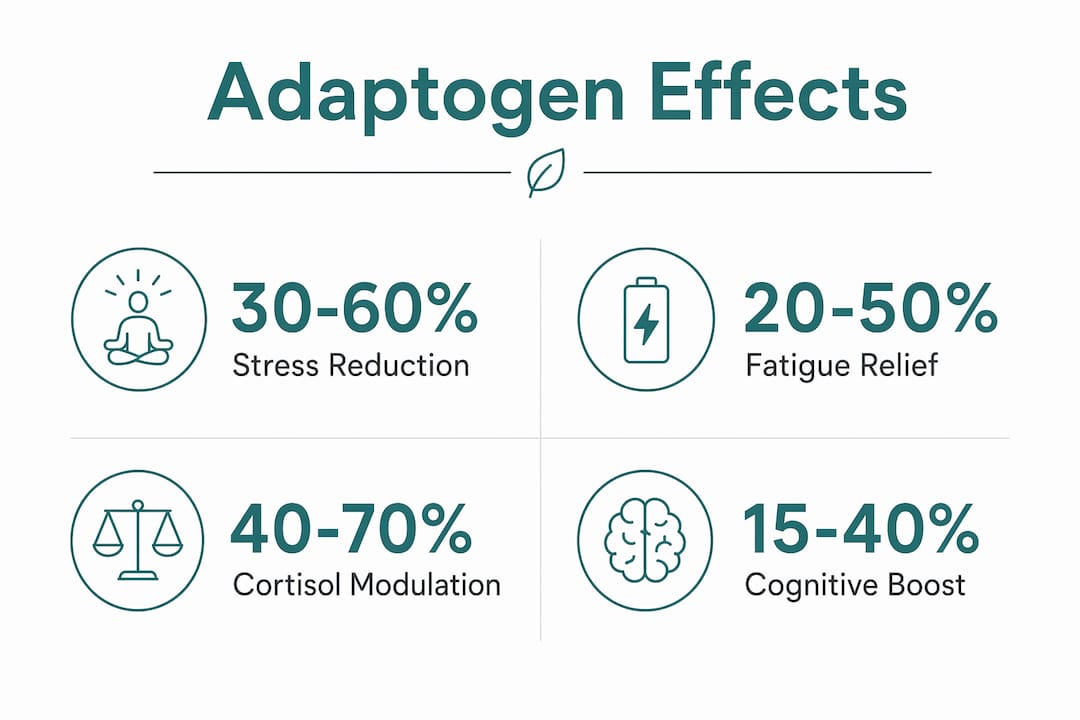
Adaptogens work by modulating stress-response systems rather than simply sedating or stimulating. The primary targets are the HPA axis and a set of molecular mediators including heat-shock protein 70 (Hsp70), the stress-kinase JNK1, and the transcription factors FOXO/DAF-16. Panossian and Wikman describe adaptogens as homeostatic regulators at molecular level, enhancing non-specific resistance to both physical and mental fatigue.

The practical implication: adaptogens do not block the stress response; they help the body return to baseline more efficiently after a stressor. Hsp70 up-regulation, in particular, is linked to cellular protection during acute stress, and its modulation by adaptogens is one of the better-characterised mechanisms in the pharmacology literature.
Evidence strength by indication:
- Fatigue and cognitive endurance: good evidence, particularly for Rhodiola rosea (SHR-5 extract) and eleuthero, with multiple clinical trials and a Bentham Science review concluding positive signals for these outcomes
- Perceived stress and cortisol: good evidence for ashwagandha; moderate for Panax ginseng
- Immune modulation: modest evidence for reishi and cordyceps; mostly small trials
- Longevity and broad immune boosting: speculative; no large, high-quality RCTs
Limits of the literature are real. Many trials use small samples, heterogeneous extract preparations, and short follow-up periods. Comparing studies is difficult when one trial uses a 1:1 whole-root extract and another uses a 10:1 concentrated extract at the same nominal dose.
Pro Tip: When reading an adaptogen trial, check four things: the extract standardisation (what active compound, at what percentage), whether there is a placebo control, the baseline stress level of the study population, and the treatment duration. A two-week trial in healthy, low-stress volunteers tells you very little about what you will experience under chronic work stress.
1. Ashwagandha (Withania somnifera)
Typical use: stress reduction, cortisol modulation, sleep quality. Strongest clinical signal: clinically relevant reductions in cortisol and perceived stress after roughly consistent use over several weeks. Caution: may stimulate thyroid activity; avoid if you have an uncontrolled thyroid condition or are on thyroid medication without medical supervision.

2. Rhodiola rosea
Typical use: mental fatigue, attention, burnout recovery. Strongest clinical signal: the SHR-5 extract has the most consistent trial record; anti-fatigue and cognitive benefits documented in healthy volunteers and burnout patients. Caution: mildly stimulating; take in the morning rather than the evening.
3. Panax ginseng
Typical use: fatigue, general weakness, cognitive function. Strongest clinical signal: recognised in a European Medicines Agency herbal monograph for reducing fatigue and improving general weakness; moderate evidence for cognitive endurance. Caution: documented interaction with warfarin; American ginseng has been shown to reduce INR in people on anticoagulants.
4. Holy basil / tulsi (Ocimum tenuiflorum)
Typical use: anxiety, blood sugar balance, general adaptogenic support. Strongest clinical signal: small trials show reductions in anxiety and stress markers; evidence base is thinner than for Rhodiola or ashwagandha. Caution: may have mild anticoagulant effects; caution alongside blood-thinning medications.
5. Eleuthero (Eleutherococcus senticosus)
Typical use: physical endurance, immune support, fatigue. Strongest clinical signal: HPA axis modulation and stamina supported by Russian clinical research; EMA monograph recognises traditional adaptogenic use. Caution: can cause anxiety or irritability at high doses; start at the lower end of the clinical range.
6. Schisandra (Schisandra chinensis)
Typical use: mental performance, liver support, stress resilience. Strongest clinical signal: included in Panossian and Wikman’s pharmacological reviews alongside Rhodiola and eleuthero as one of the better-evidenced adaptogens for fatigue and cognitive endurance. Caution: limited large-scale RCT data; evidence is mostly from smaller trials and traditional-use summaries.
7. Reishi (Ganoderma lucidum)
Typical use: immune modulation, recovery support, sleep quality. Strongest clinical signal: beta-glucans in reishi show immune-modulatory effects in small trials, including NK cell activity; some quality-of-life signals in adjunctive oncology settings. Caution: large, high-quality RCTs are limited; broad immune-boosting claims go beyond the current evidence.
8. Cordyceps
Typical use: energy, physical performance, immune support. Strongest clinical signal: small trials suggest benefits in exercise capacity and immune function; evidence base is growing but not yet robust. For immune-related context, see Vivetus’s guide to immunity supplements. Caution: as with reishi, avoid if you are on immunosuppressant therapy without medical supervision.
Safety, side effects, and who should be cautious
Adaptogens are biologically active compounds. “Natural” does not mean universally safe, and the Cleveland Clinic explicitly warns that several populations should avoid them without clinical supervision.
High-priority contraindications:
- Pregnancy and breastfeeding: most adaptogens lack safety data for these groups; avoid unless a clinician advises otherwise
- Autoimmune disease: immune-active adaptogens (reishi, eleuthero, astragalus) may amplify autoimmune activity
- Uncontrolled thyroid disease: ashwagandha may stimulate thyroid hormone production
- Warfarin and anticoagulants: ginseng reduces INR; licorice root causes pseudohyperaldosteronism (hypertension, hypokalaemia)
- Immunosuppressants: immune-modulating adaptogens may counteract the intended effect of these drugs
- Antihypertensives: licorice root in particular raises blood pressure through aldosterone-like activity
Adaptogens interact with medications and can amplify or suppress physiological processes in ways that matter clinically. Before starting any adaptogen, review your current medications and health conditions with a pharmacist or doctor — particularly if you take anticoagulants, thyroid drugs, or immunosuppressants.
The safety profile also depends on dose. Eleuthero, for example, is generally well-tolerated at clinical doses but can cause anxiety and irritability at higher amounts. Dose and formulation are not interchangeable across products.
How to take adaptogens: forms, dosing and realistic timelines
There is no single universal dose for adaptogens. The clinically studied ranges vary by herb and extract type, and the dose in a trial using a 10:1 concentrated extract is not equivalent to the same milligram amount from a whole-root powder.
| Herb | Typical clinical dose range | Common time to effect |
|---|---|---|
| Ashwagandha | — | 4–8 weeks |
| Rhodiola rosea | — | 2–4 weeks |
| Panax ginseng | — | 4–8 weeks |
| Eleuthero | — | 4–6 weeks |
| Schisandra | 500 mg/day (fruit extract) | 4–8 weeks |
| Reishi | — | 4–8 weeks |
| Cordyceps | — | 4–8 weeks |
Practical guidance on forms and timing:
- Capsules with standardised extracts are the most reliable form for matching clinical trial doses
- Tinctures offer faster absorption but variable concentration; check the extract ratio on the label
- Teas are the least concentrated form and rarely match clinical doses
- Stimulating adaptogens (Rhodiola, eleuthero, Panax ginseng) are best taken in the morning to avoid disrupting sleep
- Calming adaptogens (ashwagandha, reishi) can be taken in the evening
Ashwagandha trials specifically require consistent use over several weeks before cortisol and perceived stress scores show clinically meaningful change. Starting an adaptogen and stopping after two weeks because you feel no different is a common and understandable mistake, but it does not reflect the clinical evidence.
How to choose a quality adaptogen supplement in Central Europe
Prioritise standardised extracts, transparent dosing per serving, and third-party testing certificates. Supplement quality varies considerably across off-the-shelf products, and subtherapeutic dosing or contamination are real risks in an unregulated category.
Quality checklist:
- Standardised active constituent: look for the percentage on the label (e.g. 5% withanolides for ashwagandha, 3% salidroside for Rhodiola, standardised ginsenosides for ginseng)
- Batch testing for heavy metals and microbial contaminants: a certificate of analysis (COA) from a third-party laboratory should be available on request
- Full ingredient list: no undisclosed fillers, proprietary blends that hide individual doses, or unlisted excipients
- Contactable manufacturer: a physical address and direct contact for the manufacturer, not just a distributor
- Extract ratio stated clearly: “10:1 extract” means 10 kg of raw material concentrated to 1 kg; this matters for dose equivalence
In Central Europe, products distributed through established health retailers and online platforms with EU distribution are generally subject to food supplement labelling requirements, including ingredient disclosure and country of manufacture. Labelling in the local language of the country of sale is standard for compliant products.
Pro Tip: Choose products that use the same extract ratio and active-compound percentage as the clinical trial you are referencing. If a Rhodiola trial used SHR-5 at 3% rosavins and 1% salidroside, a product standardised to different markers at different percentages is not the same intervention, regardless of the milligram dose on the label. Request batch COAs before purchasing, particularly for products sourced outside the EU.
For a broader view of how to evaluate evidence-backed supplements, Vivetus’s guide to supplement choices after 50 covers the same quality criteria applied to longevity-focused products.
Key takeaways
Adaptogens offer genuine, evidence-backed support for stress and fatigue, but their benefits depend on the right herb, a standardised extract, consistent use over weeks, and an honest assessment of your health context.
| Point | Details |
|---|---|
| Best fit: chronic stress and fatigue | Adaptogens show the largest effects in people with elevated or chronic stress; low-stress individuals see limited measurable benefit. |
| Mechanisms are well-characterised | They modulate the HPA axis and molecular mediators (Hsp70, JNK1) rather than simply sedating or stimulating. |
| Time to effect is weeks, not days | Ashwagandha requires roughly 56–60 days; Rhodiola shows signals in 2–4 weeks; most others need 4–8 weeks. |
| Safety is not automatic | Pregnancy, autoimmune disease, anticoagulant use, and thyroid conditions are high-priority contraindications; consult a clinician first. |
| Vivetus supplements | Vivetus offers third-party tested, standardised adaptogen and longevity supplements with transparent dosing and batch COAs. |
Why evidence-based use matters more than enthusiasm
The adaptogen category has a credibility problem that is largely self-inflicted. Decades of legitimate pharmacological research, including Panossian and Wikman’s molecular work and the EMA’s herbal monographs for Rhodiola, eleuthero, and Panax ginseng, sit alongside a market flooded with products making claims that outrun the data by a considerable distance.
The honest position is this: for stress, fatigue, and cognitive endurance in people who are genuinely under sustained pressure, several adaptogens have a reasonable evidence base. Rhodiola rosea’s SHR-5 extract is probably the best-documented single adaptogen for mental fatigue. Ashwagandha has the strongest cortisol data, provided you use a standardised extract and give it two months. The mushrooms, reishi and cordyceps, have interesting immune signals but are nowhere near the same level of clinical evidence.
What the evidence does not support is the idea that adaptogens are a general wellness upgrade for everyone. The stress-physiology research is clear that effects are largest in dysregulated or chronically stressed populations. Selling adaptogens as a daily tonic for healthy people with normal stress levels is marketing, not medicine.
The practical implication for anyone in Central Europe selecting supplements: the extract standardisation and the clinical trial it references matter more than the brand story on the label. A product citing the SHR-5 extract at the studied dose is a different proposition from a generic “Rhodiola 500 mg” capsule with no standardisation data. That distinction is worth the extra five minutes of label reading.
Vivetus: clinically-backed supplements with transparent testing
For people who have read the evidence and want to act on it, the next practical step is finding products that actually match the clinical trial parameters. That is where Vivetus focuses its offering.
Vivetus provides third-party tested, standardised supplements for healthy ageing and vitality, including adaptogen-compatible formulations with transparent dosing and batch certificates of analysis. Every product is selected on the basis of clinical evidence, not marketing claims, and the full ingredient list and extract ratios are disclosed. Free shipping applies to orders over €50, with one-time and subscription purchase options available across Central Europe and internationally.
Browse the Vivetus range and check batch testing documentation at vivetus.eu.
This article is general information, not medical advice. Consult a qualified healthcare professional before starting any adaptogen supplement, particularly if you take prescription medications or have an existing health condition.
Further reading and primary sources
- Panossian A, Wikman G. Effects of Adaptogens on the Central Nervous System and the Molecular Mechanisms Associated with Their Stress-Protective Activity. PMC / Pharmaceuticals. pmc.ncbi.nlm.nih.gov/articles/PMC3991026
- Panossian A. Evidence-Based Efficacy of Adaptogens in Fatigue, and Molecular Mechanisms Related to their Stress-Protective Activity. Bentham Science / Current Clinical Pharmacology. benthamdirect.com
- Cleveland Clinic. What Are Adaptogens & Types. my.clevelandclinic.org
- VA Whole Health Library. Adaptogens. va.gov/WHOLEHEALTHLIBRARY/tools/adaptogens.asp
- ScienceDirect. Withania somnifera clinical evidence (cortisol and perceived stress trial data). sciencedirect.com
- MDPI Pharmaceuticals. Supplement purity and standardisation review. mdpi.com/1424-8247/18/8/1208
- PMC. Safety Considerations for Natural Products with Adaptogenic and Immunomodulating Activities. pmc.ncbi.nlm.nih.gov/articles/PMC12389708
- UCLA Health. What Are Adaptogens and the Possible Benefits of Taking Them. ph.ucla.edu