

NMN Side Effects in Dutch Adults: What 12 Week Trials and Vivetus Show
Short-term human trials on NMN report no serious treatment-related adverse events at doses between 250 mg and 1,250 mg per day, with tolerability confirmed across randomised, double-blind, placebo-controlled designs and a recent systematic review. The main gap is duration: no trial has run past 12 weeks, so long-term safety remains genuinely unknown.
TL;DR:
- Short-term NMN trials up to 12 weeks show no serious adverse events at doses between 250 mg and 1,250 mg daily, but long-term safety remains unproven.
- Blood NAD+ reliably increases in a dose-dependent manner without causing significant changes in liver enzymes, kidney markers, or lipid levels during these studies.
- Mild side effects such as digestive issues, sleep disturbances, headaches, or skin tingling are reported but are typically transient and manageable with proper dosing.
- The primary unknowns are long-term risks like tumor growth support or uneven NAD+ distribution across tissues, which current studies cannot confirm or exclude.
Table of Contents
- NMN bijwerkingen in clinical trials: doses, durations and safety endpoints
- What mild side effects do people actually report?
- What don’t we know about NMN’s long-term risks?
- Who should avoid NMN or talk to a doctor first?
- How much NMN is safe, and how do you monitor for problems?
- How Vivetus applies this evidence to its NMN products
- Start with a tested dose, not a guess
- An honest read on NMN bijwerkingen
- Sources
NMN bijwerkingen in clinical trials: doses, durations and safety endpoints
The evidence on NMN bijwerkingen comes almost entirely from short-duration trials, and the picture across them is consistent. Researchers keep landing on the same conclusion: NMN raises blood NAD+ reliably, and it does so without triggering the kind of laboratory red flags that would normally halt a supplement trial.
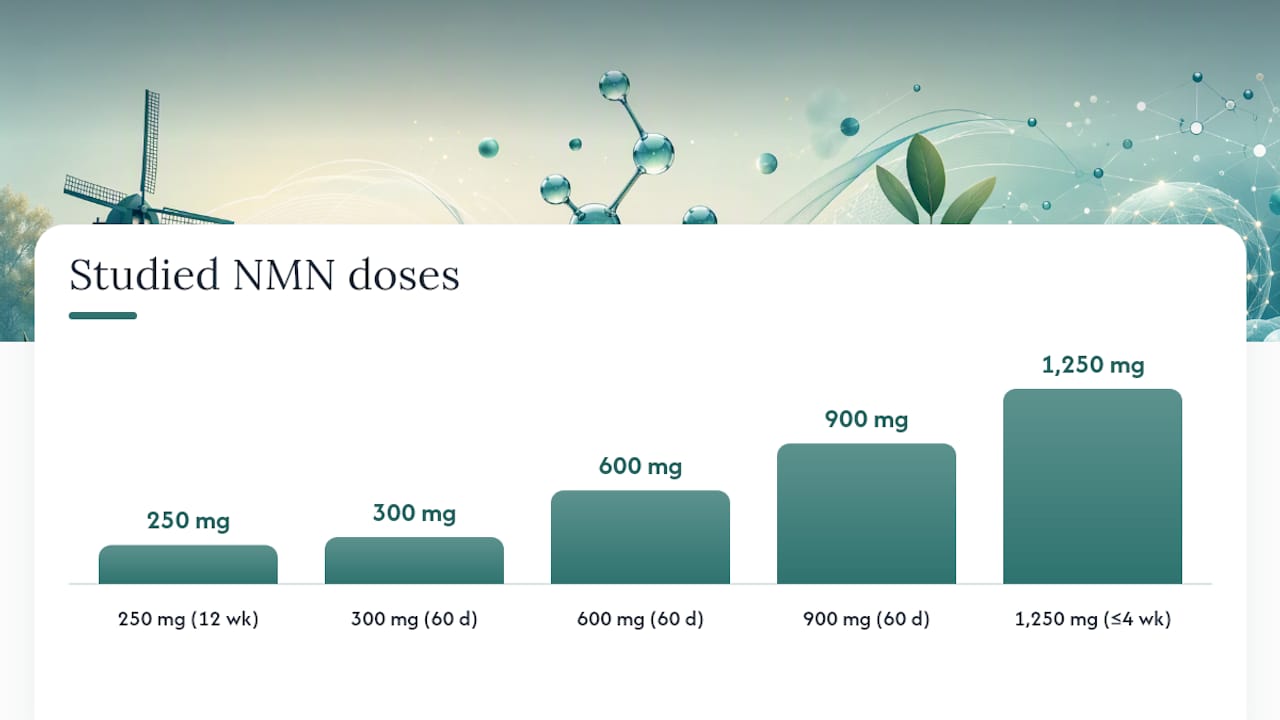
A multicentre, double-blind, placebo-controlled trial gave healthy middle-aged adults 300 mg, 600 mg or 900 mg of NMN daily for 60 days. Nine adverse events were logged across all groups combined, and none were classed as treatment-related. Blood NAD+ rose in a dose-dependent way, which is the effect researchers were looking for in the first place.
A separate 12-week study using a lower, 250 mg daily dose found the same pattern: no obvious adverse effects, no laboratory abnormalities, and a measurable rise in whole-blood NAD+. That trial matters because 250 mg sits at the lower end of what most commercial products, including Vivetus’s own powder, are formulated around.
At the higher end, a trial testing 1,250 mg once daily for up to four weeks still reported no severe adverse events and no physiologically meaningful changes on standard clinical labs. That is roughly five times the lowest studied dose, and the safety profile held.
The lab markers researchers watch most closely include:
- AST/ALT (liver enzymes) — used to catch early signs of hepatic stress
- Creatinine — a standard marker of kidney function
- Uric acid — relevant because NAD+ metabolism intersects with purine breakdown
- Lipid panels (LDL, triglycerides) — checked given NAD+'s role in metabolic pathways
Across these trials, none of these markers moved into a clinically meaningful range. A 2024 systematic review and meta-analysis pooled eight randomised controlled trials spanning 250 mg to 2,000 mg daily, with durations from 14 days to 12 weeks. Its conclusion was blunt on both fronts: NMN did not produce a significant improvement in fasting glucose or lipid markers, but it was generally safe over the trial periods studied, and it usually increased blood NAD+ as expected. That combination, no metabolic miracle but a clean safety record, is the honest summary of where the science stands. Recent trial data on physical fitness outcomes tell a similar story on functional endpoints, reinforcing that NAD+ increases are real even where metabolic markers stay flat.
What mild side effects do people actually report?
Trial data is one thing; real-world use is another. The mild effects people report while taking NMN rarely show up as “adverse events” in a clinical sense, but they are worth naming plainly so you know what is normal.
- Digestive upset. Nausea, bloating, and occasional diarrhoea are the most commonly mentioned complaints, usually mild and usually transient. Taking NMN with food, rather than on an empty stomach, tends to reduce this.
- Sleep disturbances. Some people notice difficulty falling asleep if they take NMN in the evening. NAD+ metabolism intersects with cellular energy production, so a late dose can feel mildly stimulating for some individuals. Moving the dose to the morning usually resolves it.
- Headache. Reported occasionally and inconsistently, more often in early days of use, and rarely persistent.
- Skin reactions or tingling. These are reported anecdotally rather than adjudicated in trials, so it is hard to say how much reflects the supplement versus other factors. Anyone with a history of skin sensitivity should watch for a pattern before assuming causation.
It is worth being honest about the difference between what trials measure and what consumers report. Trials use structured adverse-event reporting with a clinician adjudicating causality. Consumer reports are self-selected and unverified. Both are useful, but they answer different questions.
Pro Tip: Start at the lowest dose your product offers, take it with breakfast for the first week, and keep a short daily note of sleep, energy and digestion. If something changes, you will have a baseline to compare against rather than a vague impression.
What don’t we know about NMN’s long-term risks?
Every trial cited so far ran for 12 weeks or less. That is the honest limit of the current evidence, and it shapes everything researchers say about NMN’s long-term safety, which is: we do not yet know.
The theoretical concern that gets raised most often is tumourigenesis. NAD+ supports cellular repair and proliferation pathways, and in theory, anything that fuels healthy cell division could, in principle, also support abnormal cell growth. No human trial has shown this happening. The concern is mechanistic and precautionary, not evidence of actual harm, but it is exactly the kind of slow-developing risk a 60-day study cannot rule out.
A second open question is uptake. Oral NMN has to survive digestion and reach tissues where it can be converted into usable NAD+, and researchers still do not fully understand how consistently that happens across different organs and cell types. Blood NAD+ rising is not the same as confirming even distribution to, say, liver or neural tissue.
Other unresolved points worth knowing:
- Short randomised controlled trials are designed to catch common, fast-onset effects, not rare or delayed ones.
- No study has tracked outcomes over multiple years, so cumulative effects on organ function are unmeasured.
- Future long-term studies would ideally track cancer incidence markers, sustained lipid and liver trends, and NAD+ metabolite levels over a much longer window than 12 weeks.
None of this means NMN is dangerous. It means the safety data is real but bounded, and treating a 12-week result as proof of decades-long safety overstates what the trials actually show.
Who should avoid NMN or talk to a doctor first?
Some groups carry risks that the existing trials simply were not designed to test, because trial participants were screened to exclude exactly these situations.
- Pregnancy and breastfeeding. No safety data exists for either group, so NMN should be avoided until that data exists.
- Active cancer or recent oncology treatment. Given the theoretical link between NAD+ pathways and cell proliferation, anyone with a current or recent cancer diagnosis should discuss NMN with their oncology team before starting.
- Immunotherapy or immunosuppressant use. These treatments work by finely tuning immune activity, and introducing a supplement with metabolic effects that have not been studied alongside them is not a decision to make alone.
- Chemotherapy. The same logic applies. Prescribing clinicians need to know about any supplement being added to a treatment regime, NMN included.
Beyond these groups, the isolated lab changes seen in some trials are worth knowing about even for healthy adults. At the 900 mg dose in one multicentre trial, researchers noted small shifts in LDL and a blood marker called MCHC, and a uric acid nitrogen change at 600 mg. None were judged clinically significant by the study authors, but they illustrate why higher doses deserve more attention than lower ones. If you already monitor lipids or uric acid for another reason, mention NMN use to whoever reviews those results with you.
How much NMN is safe, and how do you monitor for problems?
Matching your dose to what has actually been studied is the simplest way to stay inside the evidence.
- Start conservative. A starting dose around 250 mg per day mirrors the lowest, longest-duration trial available and gives your body a clear baseline before any increase.
- Reassess after two to four weeks. If you tolerate the starting dose well, some people step up toward the 300 to 900 mg range studied in the 60-day trial, though there is no evidence that higher doses produce proportionally higher benefit.
- Consider baseline blood work. Liver enzymes, creatinine, uric acid and a lipid panel are the same markers trials use. Testing before you start, and again after eight to twelve weeks, gives you a genuine before-and-after comparison rather than a guess.
- Check formulation and storage. Research on NMN’s chemical stability found that degraded or poorly manufactured product can behave unpredictably, which is a plausible explanation for some unexplained reactions people report. Third-party purity testing, whether the product is powder or capsule, is not a marketing nicety here; it is the difference between knowing what you are taking and hoping.
Pro Tip: Keep the original packaging and lot number of whatever NMN product you buy. If you ever do experience an unexpected reaction, that information is the first thing worth having on hand.
Stop and contact a doctor if you notice persistent GI symptoms beyond the first week, unexplained fatigue, jaundice, or any symptom that feels disproportionate to a supplement. Trials show a strong tolerability record, not immunity from individual reactions.
How Vivetus applies this evidence to its NMN products
Vivetus formulates its NMN poeder with the trial-tested dose ranges in mind, offering 250 mg and 500 mg servings that map directly onto the doses used in the studies above rather than arbitrary round numbers chosen for marketing reasons.
- The 250 mg serving mirrors the 12-week low-dose trial, making it a sensible starting point for anyone new to NAD+ supplementation.
- The 500 mg option sits inside the 300 to 900 mg range tested over 60 days in the multicentre RCT, for those who have already tolerated a lower dose well.
- Every batch undergoes third-party purity testing, directly addressing the manufacturing-quality concern researchers flagged as a source of unexplained reactions.
- For readers combining NMN with other longevity-focused ingredients, the Energy & Vitality bundel and Longevity Plus bundel pair NMN with complementary compounds like resveratrol and TMG, following the same dosing philosophy: doses grounded in published research rather than guesswork.
Vivetus’s own reporting on NMN use for adults over 50 covers how dosing decisions should shift with age and existing health conditions, which is worth reading alongside the safety data here.
Start with a tested dose, not a guess
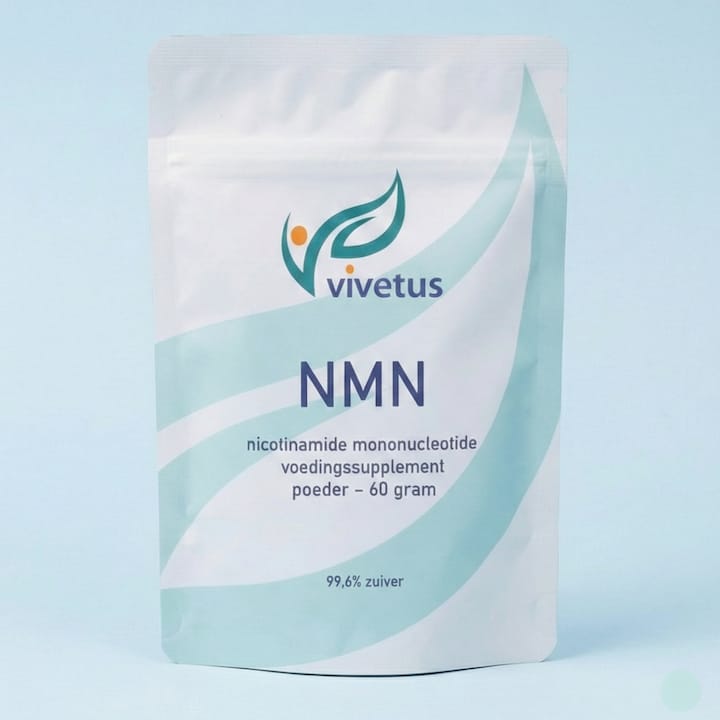
If you have read this far, you already know the doses that matter: 250 mg as a sensible starting point, up to 900 mg where trials have shown continued tolerability, and 1,250 mg as the upper edge studied so far. Vivetus’s NMN poeder is formulated at 250 mg and 500 mg per serving specifically so you can match your intake to the trial data rather than an arbitrary marketing number.
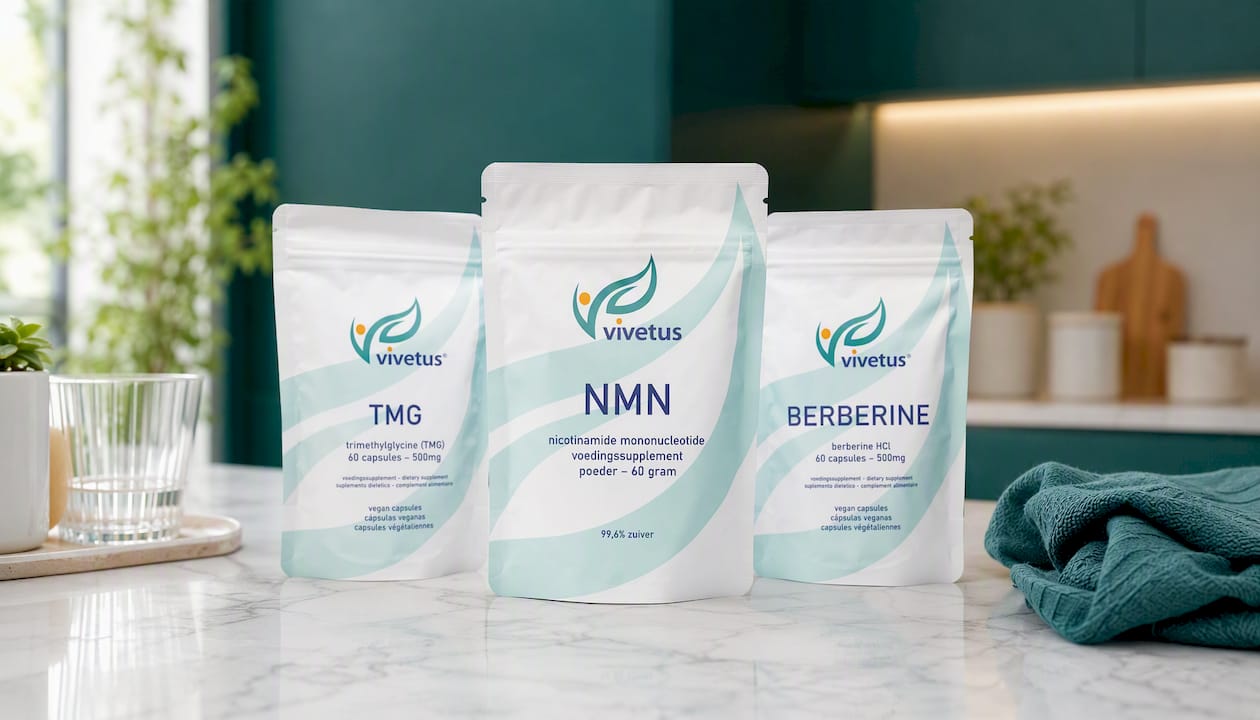
Each batch is third-party tested for purity, which matters given how much unexplained reactions trace back to degraded or poorly manufactured product rather than NMN itself. If you want a broader longevity stack alongside your NMN, the Energy & Vitality bundel pairs it with complementary compounds for daily energy support, while the Longevity Plus bundel is built for readers prioritising long-term cellular health markers. Subscription ordering is available if you plan to stay on a consistent dose, which also makes it easier to track how you respond over time. Before starting, especially if you fall into any of the higher-risk groups covered above, book a quick check with your GP so you have a baseline to compare against. Order your first pack today and start at the lower end.
An honest read on NMN bijwerkingen
The trial data is more reassuring than most supplement categories can claim, and that deserves saying plainly rather than hedged into meaninglessness. But “well tolerated for 12 weeks” and “safe for a decade of daily use” are different claims, and no one should confuse them. My honest advice: use a product with real purity testing, start low, track how you feel, and if you fall into any higher-risk group, loop in your doctor before your supplement drawer. Vivetus’s dosing and testing standards exist for exactly this reason.
— Jord
This article is general information, not a substitute for advice from a qualified doctor. Consult a qualified healthcare professional about your own circumstances before acting on anything here.
Sources
- The efficacy and safety of β-nicotinamide mononucleotide (NMN) supplementation in healthy middle-aged adults: a randomized, multicenter, double-blind, placebo-controlled trial
- Oral administration of nicotinamide mononucleotide is safe and efficiently increases blood nicotinamide adenine dinucleotide levels in healthy subjects
- Safety evaluation of β-nicotinamide mononucleotide oral administration in healthy adult men and women | Scientific Reports
- Effects of nicotinamide mononucleotide on glucose and lipid metabolism in adults: a systematic review and meta-analysis of randomised controlled trials