

Adaptogens in Supplements: Science-Backed Benefits for Vitality
Adaptogen supplements have attracted both enthusiasm and skepticism in equal measure. Many people dismiss them as wellness trends with little substance behind them. Yet modern research is telling a different story. Specific adaptogens, including Ashwagandha and Rhodiola, now have clinical trial data supporting their effects on cortisol, sleep, muscle strength, and cognitive function in older adults. This article covers what adaptogens are, how they work biologically, which ones have the strongest evidence for healthy aging, and how to use them safely and effectively.
Table of Contents
- What are adaptogens and why are they used in supplements?
- How adaptogens work: The science behind stress and ageing
- Which adaptogens are best for healthy aging and vitality?
- Risks, limitations, and expert perspectives on adaptogens
- How to incorporate adaptogens safely and effectively
- Explore quality adaptogen options for healthy ageing
- Frequently asked questions
Key Takeaways
| Point | Details |
|---|---|
| Adaptogens support resilience | Specific adaptogens help the body adapt to stress and support healthy aging through multitarget biological effects. |
| Evidence prefers Ashwagandha | Ashwagandha stands out for clinical proof in reducing stress, boosting vitality, and improving sleep and muscle strength. |
| Safe use needs caution | Adaptogens are generally safe short-term but can pose risks and require quality control and medical consultation. |
| Synergy with lifestyle matters | Adaptogens work best when combined with healthy diet, exercise, and stress management strategies. |
| Choose quality, not hype | Opt for standardized, evidence-backed adaptogen supplements and avoid broad, unsupported health claims. |
What are adaptogens and why are they used in supplements?
Adaptogens are a specific category of plants and fungi with a precise definition. Non-toxic plants or mushrooms that help the body resist stressors by modulating the HPA axis (the hypothalamic-pituitary-adrenal axis, your central stress response system). That distinction matters. Not every herb qualifies. To be classified as an adaptogen, a substance must be non-toxic at normal doses, produce a non-specific stress response, and normalize body functions without pushing them in one direction.
Historically, adaptogens were central to traditional medicine systems across Asia and Russia. Siberian researchers in the mid-20th century formalized the term, studying plants like Eleutherococcus for their effects on worker endurance and resilience. Today, the interest has shifted to supplement form because it offers standardized dosing, convenience, and targeted delivery of active compounds.
Adaptogens promote homeostasis without disrupting normal function.
The most commonly used adaptogens in supplements include:
- Ashwagandha (Withania somnifera): stress, sleep, testosterone
- Rhodiola rosea: endurance, mental fatigue, mood
- Panax ginseng: cognitive function, energy, immune support
- Reishi mushroom (Ganoderma lucidum): immune modulation, sleep quality
- Holy basil (Ocimum tenuiflorum): cortisol balance, inflammation
- Eleuthero (Siberian ginseng): physical performance, stress resistance
You can explore a broader list of common adaptogens and their primary applications. For context on how these fit into a broader wellness strategy, the healthy ageing guide on Vivetus provides a useful framework.
Adaptogens are not a cure-all. The evidence supports specific uses for specific compounds. Broad claims about any single adaptogen solving every health problem are not supported by current science.
How adaptogens work: The science behind stress and ageing
Adaptogens act through several biological pathways simultaneously. They regulate cortisol, increase heat shock proteins, modulate neurotransmitters, reduce inflammation, and enhance mitochondrial function. Each of these mechanisms contributes to stress resilience and healthy ageing in a distinct way.
Cortisol is your primary stress hormone. Chronically elevated cortisol accelerates cellular ageing, disrupts sleep, and impairs immune function. Adaptogens help regulate its release, keeping it within a functional range rather than suppressing it entirely. Heat shock proteins are cellular repair molecules. When adaptogens mildly stress cells, they trigger the production of these proteins, making cells more resilient to future damage. This process is called hormesis: a low-dose stressor that produces a stronger adaptive response.
Neurotransmitter modulation explains why some adaptogens reduce anxiety and improve mood without causing sedation. They influence serotonin and dopamine pathways without the dependency risks associated with pharmaceutical interventions. Some adaptogens also support mitochondrial efficiency, which is directly relevant to energy levels and the antioxidants for ageing conversation.
Cortisol reductions of 20 to 30 percent have been recorded in clinical trials using specific adaptogens, particularly Ashwagandha. That is a clinically meaningful shift, not a marginal effect.
| Feature | Adaptogens | Non-adaptogenic stimulants |
|---|---|---|
| Energy effect | Gradual, sustained | Rapid, short-lived |
| Crash risk | Low | High |
| Dependency potential | Minimal | Moderate to high |
| Cortisol impact | Reduces or normalizes | Often increases |
| Sleep quality | Neutral to positive | Often disrupted |
| Mechanism | Multi-pathway, regulatory | Primarily stimulatory |
The contrast with stimulants like caffeine is instructive. Stimulants push the system harder. Adaptogens help the system regulate itself more efficiently.
Which adaptogens are best for healthy aging and vitality?
Not all adaptogens are equal in terms of clinical evidence. Some have robust trial data; others rely primarily on traditional use and animal studies. Here is a summary of the most evidence-backed options for healthy aging.

| Adaptogen | Primary benefit | Typical dose | Population studied | Evidence quality |
|---|---|---|---|---|
| Ashwagandha | Stress, sleep, testosterone | 300 to 600 mg/day | Adults 40 to 70 | Strong (RCTs) |
| Rhodiola rosea | Endurance, mental fatigue | 200 to 400 mg/day | Adults, athletes | Moderate |
| Panax ginseng | Cognition, energy | 200 to 400 mg/day | Older adults | Moderate |
| Reishi mushroom | Immune support, sleep | 1 to 1.5 g/day | Mixed adult groups | Emerging |
| Holy basil | Cortisol, inflammation | 300 to 600 mg/day | Adults with stress | Limited |
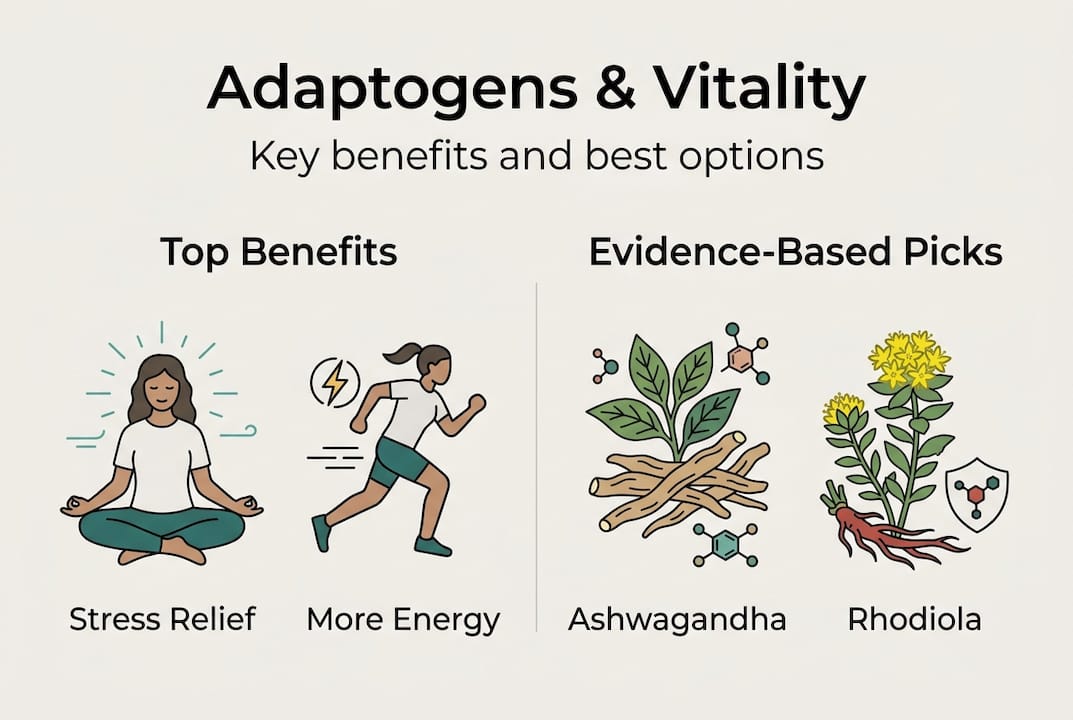
Ashwagandha stands out. Clinical data shows it reduces cortisol by 11 to 32 percent, improves stress and anxiety scores, boosts muscle strength and size, enhances sleep quality, and increases testosterone in older adult males. Rhodiola has solid support for improving physical endurance and reducing mental fatigue, particularly in high-demand situations.
For clinical adaptogen trials covering broader populations, the data is growing but still limited in terms of long-term follow-up. Practical selection tips:
- Choose standardized extracts (e.g., KSM-66 or Sensoril for Ashwagandha)
- Verify the active compound percentage on the label
- Avoid proprietary blends where individual doses are hidden
- Consider stacking only when individual responses are established
- Review the choosing supplements for aging guide before purchasing
Pro Tip: Prioritize standardized, evidence-backed adaptogens like Ashwagandha before exploring less-studied options. Consult your healthcare provider if you take any medications or have hormone-sensitive conditions.
Risks, limitations, and expert perspectives on adaptogens
Adaptogens are generally well tolerated, but that does not mean risk-free. Side effects are rare and mild, but documented risks include the following:
- Gastrointestinal upset: Nausea or loose stools, particularly at higher doses or on an empty stomach.
- Insomnia: Some adaptogens, especially stimulating ones like Rhodiola, can disrupt sleep if taken late in the day.
- Liver toxicity: Rare but documented cases linked to Ashwagandha, especially with high doses or prolonged use.
- Drug interactions: Adaptogens can interact with thyroid medications, immunosuppressants, sedatives, and blood thinners.
- Hormone changes: Ashwagandha affects thyroid and testosterone levels, requiring monitoring in relevant populations.
- Unregulated quality: Many products on the market lack third-party testing, so label claims may not reflect actual content.
Evidence gaps are also significant. Most trials are short-term, often 8 to 12 weeks. Long-term safety data beyond six months is limited. Trial populations are often small and not always representative of older adults or those with chronic conditions.
Adaptogens are best seen as supplements, not replacements for lifestyle.
This view is supported by contrasting expert opinions that classify overall evidence as weak to moderate for many adaptogens. Individual evaluation is essential. What works well for one person may be unsuitable for another, especially when medications or existing health conditions are involved. For broader context on how nutrition supports aging, the diet for healthy ageing resource is worth reviewing.
How to incorporate adaptogens safely and effectively
Adding adaptogens to your routine requires a structured approach. Short-term use under six months is currently recommended, with standardized extracts preferred over raw powders or unverified blends.
Practical dos and don’ts:
- Do start with one adaptogen at a time to evaluate your individual response
- Do choose products with verified standardization and third-party testing
- Do consult your healthcare provider before starting, especially if you have existing conditions
- Do take adaptogens consistently for at least four weeks before assessing effects
- Don’t exceed recommended doses hoping for faster results
- Don’t use adaptogens as a substitute for sleep, exercise, or a balanced diet
- Don’t combine multiple adaptogens without understanding each one individually
- Don’t ignore side effects; stop use and seek advice if anything unusual happens
Synergy matters. Adaptogens work best when combined with consistent physical activity, adequate sleep, and anti-inflammatory nutrition. The anti-ageing nutrition guide outlines how dietary choices complement adaptogen use for sustained vitality.
Pro Tip: Combine a standardized Ashwagandha supplement with regular resistance training and a whole-food diet. This combination has the strongest combined evidence base for supporting vitality and healthy ageing in adults over 40.
Explore quality adaptogen options for healthy ageing
If you have read this far, you now have a clear, evidence-based picture of what adaptogens can and cannot do. The next step is finding products that meet the quality standards discussed here: standardized extracts, transparent labeling, and third-party verification.
Vivetus offers a curated range of scientifically supported supplements for healthy ageing and vitality. Each product is selected with quality and evidence in mind, making it straightforward to find options that align with what the research actually supports. For further reading before you purchase, the healthy ageing practical guide and the supplement selection advice page provide structured guidance on building a supplement routine that fits your specific health goals.
Frequently asked questions
Are adaptogen supplements safe for daily use?
Adaptogen supplements are generally safe for short-term daily use, with side effects rare and mild. Use beyond six months requires provider oversight due to limited long-term safety data.
Which adaptogen is best for stress reduction?
Ashwagandha has the strongest clinical evidence, with trials showing it reduces cortisol by 11 to 32 percent and consistently improves stress and anxiety scores across multiple studies.
Do adaptogens improve ageing and vitality?
Selected adaptogens show meaningful clinical support. Ashwagandha boosts muscle strength, testosterone, and sleep in older adults, while Rhodiola improves physical endurance and reduces mental fatigue.
Are adaptogens a substitute for lifestyle or medication?
No. Adaptogens are adjuncts to a healthy lifestyle, not replacements. Overall evidence remains weak to moderate for many compounds, and they do not replace proven medical treatments or lifestyle habits.
How should I choose a quality adaptogen supplement?
Select standardized extracts with provider consultation, verify third-party testing, and avoid proprietary blends that obscure individual ingredient doses.