

Why protein is key for healthy ageing and vitality
TL;DR:
- Protein is essential for muscle retention, immunity, and bone health in older adults.
- Aging reduces muscle response to protein, requiring higher intake and even distribution across meals.
- Combining adequate dietary protein with resistance exercise optimizes healthy aging and independence.
Protein is not just a concern for athletes or bodybuilders. For middle-aged and older adults, it is one of the most critical dietary factors determining whether you remain strong, mobile, and independent as the decades pass. Protein supports muscle, immunity, and bone density simultaneously, yet most people over 50 are consuming far less than their bodies actually require. This article clarifies exactly how much protein you need, why those needs increase with age, where to find the best sources, and how to make practical changes that genuinely support your vitality.
Table of Contents
- What happens to our muscles and health as we age?
- Why protein needs increase: science and recommendations
- The best protein sources for healthy ageing
- How to get enough protein: practical strategies and common pitfalls
- The surprising truth about protein for healthy ageing: what most guides miss
- Connect healthy ageing with Vivetus solutions
- Frequently asked questions
Key Takeaways
| Point | Details |
|---|---|
| Protein needs rise with age | Older adults require more protein than younger people to maintain muscle, strength, and vitality. |
| Spread intake across meals | Distributing protein evenly throughout the day helps maximise muscle repair and growth. |
| Both animal and plant sources work | A blend of protein types can meet needs if intake is sufficient and meals are balanced. |
| Supplements may help some | Those unable to meet needs from food, especially with illness or poor appetite, may benefit from targeted protein supplements. |
What happens to our muscles and health as we age?
Most people accept some physical decline as an inevitable part of getting older. The reality is more nuanced, and far more hopeful, than that assumption suggests. Biology does create real challenges, but nutrition can powerfully counteract many of them.
After the age of 40 to 50, the body begins losing muscle mass at an accelerating rate. This process is called sarcopenia, and it affects both the quantity and the quality of muscle tissue. Left unchecked, sarcopenia reduces strength, slows metabolism, impairs balance, and substantially raises the risk of falls, fractures, and loss of independence. The rate of muscle loss can reach 1 to 2 percent per year after the age of 50, with that rate increasing further after 70.
One of the core biological mechanisms behind this is a phenomenon called anabolic resistance. In younger adults, eating a moderate serving of protein reliably triggers muscle protein synthesis, the process by which the body builds and repairs muscle fibres. As we age, anabolic resistance develops, meaning the muscles become significantly less responsive to the same protein stimulus. The signal that used to work at 30g of protein may now require 40g or more to achieve the same response.
Hormonal changes compound this problem. Declining levels of testosterone, oestrogen, and growth hormone all reduce the body’s natural capacity to preserve and build muscle. Chronic low-grade inflammation, common in older adults, also disrupts muscle protein turnover. Together, these factors create a biological environment that is actively working against muscle retention.
“Protein is essential for healthy ageing—it supports not only muscle maintenance but also immunity, organ function, and bone health.” — National Council on Ageing
The important point is this: protein supports muscle and these other systems in ways that remain responsive to dietary change, even in later life. Decline is real, but it is not fixed. Explore our practical ageing guide for a broader view of lifestyle factors that interact with nutrition.
| Age group | Approximate muscle loss rate | Key contributing factors |
|---|---|---|
| 30 to 40 | Minimal (less than 0.5% per year) | Hormonal shifts beginning |
| 40 to 50 | Moderate (around 0.5 to 1% per year) | Anabolic resistance emerging |
| 50 to 60 | Notable (1 to 1.5% per year) | Reduced hormones, inflammation |
| 60 and over | Significant (up to 2% or more per year) | Cumulative biological changes |
Why protein needs increase: science and recommendations
Understanding muscle loss is one thing, but how much protein is actually enough, and why do these needs shift with age?
The standard dietary recommendation for adults has historically been 0.8 grams of protein per kilogram of body weight per day. This figure was established primarily to prevent deficiency, not to optimise muscle health in older adults. Emerging research consistently shows it is insufficient for people over 50, particularly those who are physically active or already experiencing muscle loss.
Current evidence-based guidance is considerably higher. Recommended protein intake for older adults falls between 1.0 and 1.2 grams per kilogram per day as a baseline, rising to 1.5 to 1.7 grams per kilogram per day for those who exercise regularly, have sarcopenia, or are recovering from illness or injury. For a 70kg adult, that translates to roughly 70 to 84 grams per day at the baseline level, and up to 105 to 119 grams per day for those with higher needs.
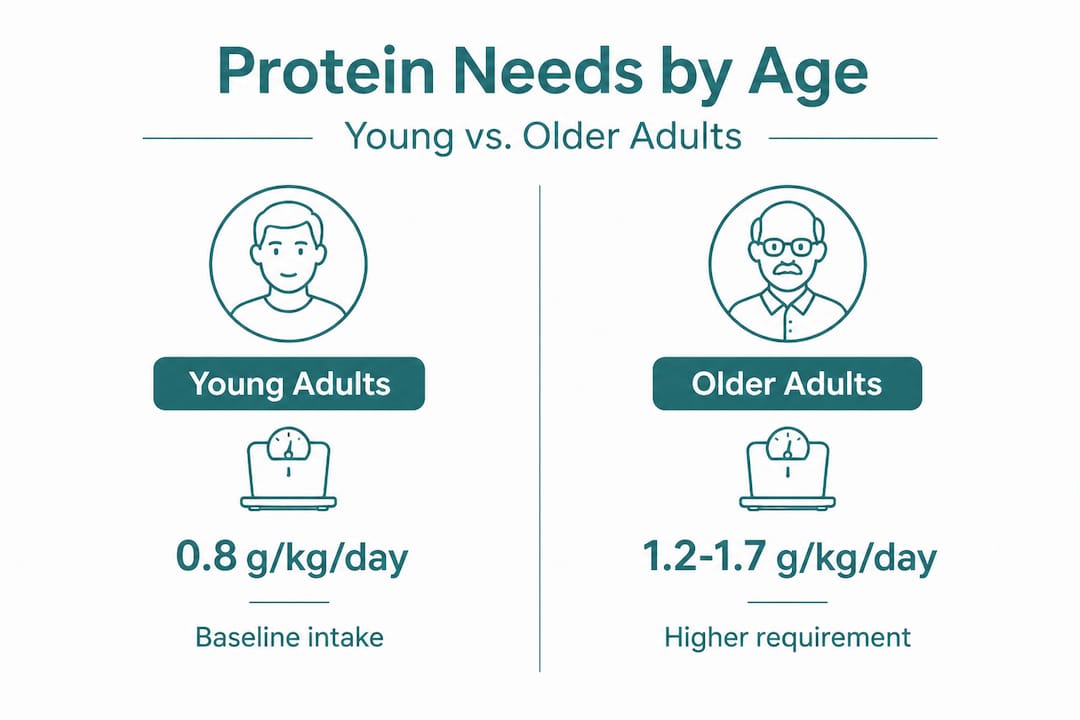
The evidence for prioritising higher intake is compelling. High protein intake of 1.0 grams per kilogram per day or above is associated with meaningfully lower risks of falls, frailty, and all-cause mortality in older adults. These are not marginal differences. They represent outcomes that directly determine quality of life and independence in later years.
Key benefits of meeting or exceeding the recommended intake include:
- Preservation of lean muscle mass during ageing and periods of lower activity
- Faster recovery from illness, surgery, or injury
- Stronger immune function, as antibodies and immune cells are protein-dependent
- Better bone density, since bone matrix includes significant protein components
- Improved metabolic rate, because muscle tissue burns more energy at rest
The following comparison illustrates how protein needs shift across age groups:
| Group | Recommended intake | Notes |
|---|---|---|
| Young adults (18 to 35) | 0.8 g/kg/day | RDA baseline for prevention of deficiency |
| Middle-aged adults (35 to 60) | 1.0 to 1.2 g/kg/day | Anabolic resistance beginning |
| Older adults (60 and over) | 1.0 to 1.2 g/kg/day minimum | Higher if active or with sarcopenia |
| Active older adults or sarcopenic | 1.5 to 1.7 g/kg/day | To overcome anabolic resistance |
For further guidance on specific supplementation approaches, our supplements guide for ageing provides detailed, evidence-based recommendations.
The best protein sources for healthy ageing
So, what should you actually put on your plate to meet these requirements?
Protein quality matters as much as quantity, and this distinction becomes especially important as we age. The key factor is amino acid completeness, specifically the presence of all nine essential amino acids that the body cannot produce on its own. Equally important is leucine, an amino acid that directly activates muscle protein synthesis. Research consistently shows that each meal should contain at least 2.5 to 3 grams of leucine to trigger meaningful muscle building.
Animal proteins, including meat, fish, eggs, and dairy products, provide all essential amino acids in proportions well-suited to human muscle maintenance. They are particularly rich in leucine. Animal proteins are superior for muscle protein synthesis due to their complete essential amino acid profiles and leucine content, but plant blends or fortified sources can match these benefits when total intake reaches 1.6 grams per kilogram or more per day.
Top animal protein sources for older adults:
- Eggs: around 6g protein per egg, with excellent leucine content and high digestibility
- Greek yoghurt: 15 to 20g per serving, plus calcium and probiotics for digestive and bone health
- Salmon and oily fish: 25g per serving, with added omega-3 benefits for inflammation and joint health
- Chicken breast: 30g per 100g, lean and versatile for a wide range of meals
- Cottage cheese: high in casein protein, which digests slowly and supports overnight muscle repair
For those following plant-based diets, meeting protein needs is entirely achievable with careful planning. The most effective plant sources include:
- Soya products (tofu, tempeh, edamame): the only plant proteins with a complete essential amino acid profile comparable to animal sources
- Legumes combined with grains: for example, lentils with brown rice or chickpeas with quinoa
- Pea protein powder or hemp seed: useful for boosting leucine-poor plant meals
- Fortified plant milks and yoghurts: help supplement calcium alongside protein
Pro Tip: If you follow a plant-based diet, combining a leucine-rich supplement such as pea protein with meals that include legumes and grains is one of the most efficient ways to overcome the leucine gap without relying heavily on animal products.
A mixed dietary approach, drawing on both animal and plant proteins, is associated with the strongest outcomes for overall health and longevity. You can review top nutritional products selected specifically to complement these dietary patterns.
How to get enough protein: practical strategies and common pitfalls
Theory is vital, but practical steps make the difference. Here is how to hit your targets consistently.

One of the most important and frequently overlooked principles is meal distribution. Many older adults consume the majority of their protein at the evening meal, eating little at breakfast and only a modest amount at lunch. This pattern is far less effective than spreading protein evenly across all three main meals. The muscles can only use a limited amount of protein for synthesis at one sitting, roughly 25 to 40 grams per meal, so concentrating intake at dinner wastes a significant portion of that day’s protein.
Steps to improve your protein distribution and overall intake:
- Start with breakfast: include eggs, Greek yoghurt, or a protein smoothie. Breakfast is the meal most commonly lacking in protein.
- Plan each meal around a protein source: rather than treating protein as a side item, make it the centrepiece of what you eat.
- Aim for 25 to 40g per meal: this range is both achievable and sufficient to stimulate muscle protein synthesis effectively at each sitting.
- Add a mid-morning or afternoon protein snack if needed: options like cottage cheese, a handful of nuts, or a protein bar can bridge gaps without major effort.
- Read labels carefully: many foods marketed as high in protein actually contain far less than you might expect. Check grams per serving, not just percentage of reference intake.
- Consider a supplement if dietary intake is consistently short: protein powders, particularly whey or plant-based blends, are practical tools when appetite is reduced or meal planning is difficult.
Protein supplementation shows measurable benefits in older adults managing long-term conditions or sarcopenia, particularly when combined with resistance exercise, though supplementation alone in otherwise healthy adults produces smaller gains. This reinforces that supplements work best as part of a broader dietary and lifestyle strategy, not as a standalone fix. For details on when and how supplements can help, see our guide to supplement advantages and review our supplement safety tips before starting any new product.
Common pitfalls to avoid:
- Relying almost entirely on the evening meal for protein
- Skipping breakfast or replacing it with only toast or fruit
- Assuming plant-based eating automatically meets protein needs without tracking intake
- Ignoring protein needs during illness or recovery, when requirements actually increase
- Choosing protein supplements without checking for allergens, quality certifications, or appropriate leucine content
Pro Tip: Resistance exercise, even moderate bodyweight training two to three times per week, significantly amplifies the muscle-building effect of each gram of protein you consume. Nutrition and movement work together. Neither alone is as effective as the combination.
The surprising truth about protein for healthy ageing: what most guides miss
Most mainstream articles on protein for older adults cover the basics adequately. What they tend to miss is the nuance that separates adequate intake from genuinely optimal intake.
The first overlooked point is that per-meal protein matters more than most people realise. It is not enough to hit a daily total if most of that total arrives in one sitting. The muscle protein synthesis response has a ceiling per meal. Distributing protein evenly across three meals is fundamentally more effective than consuming the same total in an uneven pattern. Many otherwise well-nourished adults are essentially leaving muscle-building potential on the table simply through poor timing.
The second point that guides frequently underemphasise is the non-negotiable role of resistance exercise. Protein intake without movement is significantly less effective for preserving muscle. The combination of adequate protein and regular resistance training produces results that neither achieves independently. If you focus exclusively on dietary changes without addressing physical activity, you are working with one hand tied.
Third, the debate over animal versus plant protein can become a distraction from the more important variable: total intake and distribution. Whether your protein comes primarily from chicken or primarily from legumes matters far less than whether you are consistently reaching the recommended grams per kilogram per day at each meal. Fixating on protein source at the expense of total intake is a common and costly error.
Fourth, personalisation is essential. Individuals with chronic kidney disease should not follow standard higher-protein recommendations without medical guidance. Those recovering from surgery, managing cancer treatment, or dealing with severe sarcopenia may need intakes at the upper end or beyond standard ranges. One figure does not fit every situation.
Finally, evidence-backed supplementation is a practical tool, not a replacement for whole foods. Whole food protein sources bring with them fibre, micronutrients, and bioactive compounds that no supplement replicates. Supplements fill gaps. Whole foods build the foundation.
Connect healthy ageing with Vivetus solutions
For ongoing support and evidence-based resources, connect your learning with trusted solutions.
At Vivetus, the focus is on providing carefully selected, scientifically supported products and guidance for adults committed to healthy ageing. Whether you are looking to close a dietary protein gap, explore supplementation that complements your current routine, or access clear information about what the evidence actually supports, Vivetus offers a structured range of resources and nutritional products designed with your goals in mind.
Free shipping on orders over €50 makes it straightforward to stock up on what you need without unnecessary cost. The product range spans protein supplements, targeted nutritional support, and broader vitality-focused formulations, all selected to align with the latest research on healthy ageing. Use the website’s product catalogue and informational guides to continue building the practical, evidence-based approach that genuinely supports your independence and vitality in the years ahead.
Frequently asked questions
Can you get enough protein from plants as an older adult?
Yes, but it requires careful planning and a higher total intake or use of fortified and mixed plant sources. Plant blends can match animal protein benefits when total intake reaches 1.6 grams per kilogram per day or more, making dietary strategy essential.
Is too much protein harmful for older adults?
For most healthy older adults, higher protein intakes within the recommended range of 1.0 to 1.7 grams per kilogram per day are safe and beneficial. Those with kidney disease or specific medical conditions should consult their doctor before increasing intake.
Do I need protein supplements if I eat well?
Protein supplementation is not necessary when dietary intake is consistently adequate, but it is a practical and effective tool for those with low appetite, illness, increased needs, or difficulty meeting targets through food alone.
What is the best time to eat protein for muscle health?
Even distribution across main meals is more effective than concentrating intake at one sitting. Spread protein evenly across meals, aiming for 25 to 40 grams per serving, with at least 2.5 to 3 grams of leucine per meal to reliably stimulate muscle protein synthesis.