

Track supplement benefits for real results and healthy ageing
TL;DR:
- Supplement efficacy varies between individuals due to biological and lifestyle factors. Tracking supplement responses through diaries, blood tests, challenge tests, or wearables helps personalize and optimize their use. Systematic measurement prevents guesswork, reduces risks, and enhances understanding of what truly benefits your health.
Supplement efficacy varies significantly between individuals and depends on several biological and lifestyle factors. Most people take a supplement, wait a few weeks, and then decide whether it is working based on a vague sense of feeling better or worse. That approach misses a great deal. Research confirms that individual differences in age, genetics, health status, and activity level all shape how your body responds to a given supplement. Without a structured way to observe those responses, you are left guessing. Tracking your supplement benefits is not complicated, but it does require intention and consistency.
Table of Contents
- Why supplement efficacy is not one-size-fits-all
- How to track supplement benefits: Tools and practical approaches
- What the evidence shows: Real results from supplement tracking
- Common pitfalls and expert tips for effective benefit tracking
- Our take: Why tracking beats guesswork for your health journey
- Discover proven supplement solutions for healthy ageing
- Frequently asked questions
Key Takeaways
| Point | Details |
|---|---|
| Tracking uncovers real effects | Recording supplement use and effects helps you see what truly benefits your health. |
| Personalisation is essential | Supplements work differently for each person—tracking shows what suits you. |
| Data beats guesswork | Evidence-based tracking avoids wasted money and overdosage risks. |
| Practical tools available | From simple journals to biomarker tests, tracking can be tailored to your needs. |
| Avoid common mistakes | Track one change at a time and consult professionals for safe, actionable results. |
Why supplement efficacy is not one-size-fits-all
The idea that a supplement either works or it does not is too simple. Supplement effectiveness depends on type, dose, gender, age, and activity level, according to systematic reviews of the evidence. A magnesium supplement may significantly improve sleep quality in an older adult with a deficiency but produce no noticeable effect in a younger person with adequate dietary intake. The same logic applies to vitamin D, omega-3 fatty acids, and dozens of other widely used products.
This variability is not a flaw in the research. It reflects the reality of human biology. Your gut microbiome, liver enzyme activity, and baseline nutrient levels all influence absorption and utilisation. Two people taking the same dose of the same supplement can experience very different protein supplement trial outcomes.
“What works well for one person may do little for another. Personalisation is not a marketing term here. It is a biological fact.”
The placebo effect adds another layer of complexity. When people expect a supplement to work, they often report improvements even when the product has no active effect. Without a tracking system, it is nearly impossible to separate genuine benefit from expectation.
There are also practical risks to ignoring individual response. Taking higher doses in the hope of faster results can lead to overdosage, particularly with fat-soluble vitamins such as A, D, E, and K. Wasted investment is another concern. If you spend months on a product that is not suited to your biology, you gain nothing and lose both money and time.
Tracking gives you the data to make informed decisions. It allows you to personalise your supplement routine based on what your body actually shows, rather than what a label promises. When you read about choosing supplements for healthy ageing, the underlying message is the same: individual context matters more than general claims.
Key reasons efficacy varies between individuals:
- Age-related changes in absorption and metabolism
- Genetic differences in enzyme activity
- Existing nutrient deficiencies or surpluses
- Current health conditions and medications
- Physical activity level and type
- Diet composition and meal timing
| Factor | Example of impact |
|---|---|
| Age | Older adults absorb B12 less efficiently |
| Gender | Iron needs differ significantly between men and women |
| Activity level | Athletes may need higher protein or electrolyte doses |
| Health status | Deficiency states amplify supplement response |
How to track supplement benefits: Tools and practical approaches
Tracking does not require a laboratory. It starts with simple, consistent observation and builds from there depending on how much detail you want.
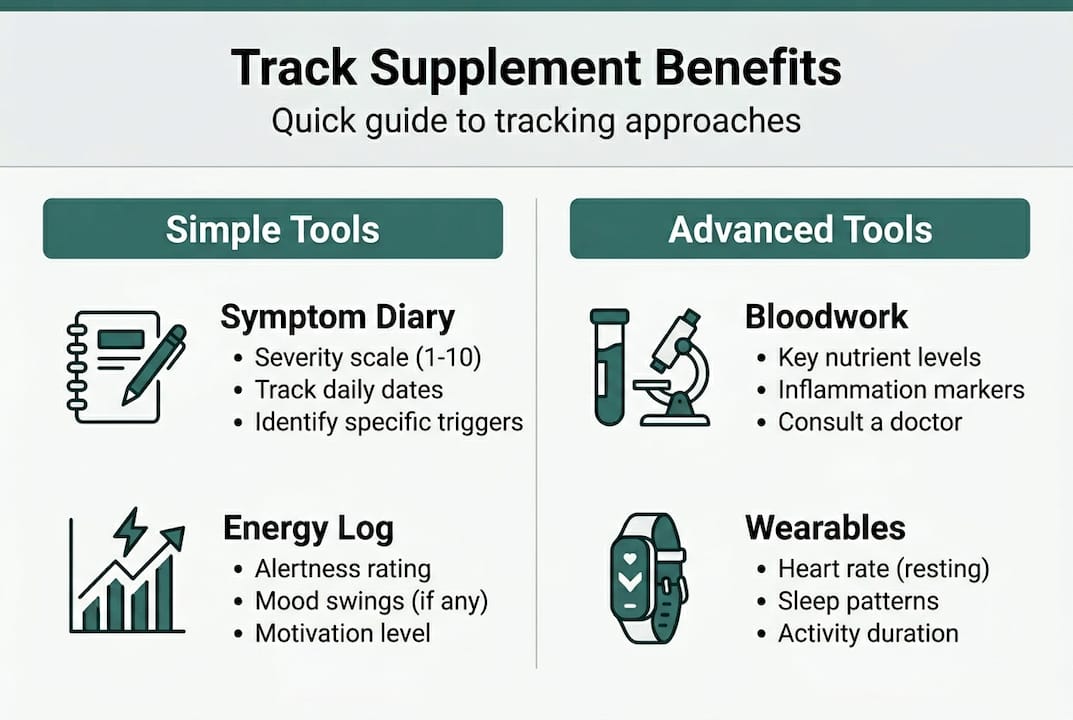
The most accessible method is a symptom and energy diary. Each day, note your energy level, mood, sleep quality, and any physical symptoms on a scale of one to ten. Record the supplement you took, the dose, and the time. After four to eight weeks, patterns begin to emerge. This approach costs nothing and takes less than two minutes per day.
For those who want more objective data, bloodwork is a reliable next step. A baseline blood panel before starting a supplement, followed by a repeat panel after eight to twelve weeks, gives you measurable evidence of change. Markers such as serum vitamin D, ferritin, CRP, and HbA1c can all shift in response to targeted supplementation.
Multi-biomarker panels and challenge tests go further by visualising personalised health improvements and resilience under physiological stress. The PhenFlex challenge test, for example, measures how your body responds to a metabolic stressor before and after a supplement protocol. It can reveal subtle improvements in metabolic flexibility that a standard blood panel would miss.
Wearable devices such as fitness trackers and continuous glucose monitors add another dimension. They capture sleep stages, resting heart rate, and activity recovery in real time, giving you a continuous record rather than a single snapshot.

Pro Tip: Always take your supplement at the same time each day and under the same conditions, such as with food or fasting, to reduce variability in your tracking data. Inconsistent timing is one of the most common reasons patterns fail to emerge.
When choosing a tracking method, consider the following comparison:
| Method | Cost | Ease of use | Reliability |
|---|---|---|---|
| Symptom diary | Free | Very easy | Moderate |
| Blood panel | Moderate | Requires GP | High |
| Challenge test | Higher | Specialist needed | Very high |
| Wearable device | Variable | Easy | Moderate to high |
For a broader foundation, reviewing an evidence-backed supplements guide before you begin tracking helps you set realistic expectations. You may also find it useful to understand how antioxidants for ageing interact with your baseline health markers before adding them to your routine.
What the evidence shows: Real results from supplement tracking
Data from controlled trials gives us a useful benchmark for what to expect when tracking is done properly.
Protein supplementation is one of the most studied areas. Systematic tracking with empirical benchmarks shows a standardised mean difference (SMD) of 0.37 for endurance outcomes and 0.72 for strength outcomes when comparing protein supplementation to placebo. In plain terms, the effect on strength is nearly twice as large as the effect on endurance, and both are measurable only because researchers tracked outcomes consistently.
Caffeine shows a similar pattern. Its effect size varies depending on the outcome measured, the dose used, and the individual’s habitual intake. Without tracking, a regular coffee drinker might attribute performance improvements to caffeine when tolerance has already blunted most of the effect.
For ageing-related supplements, the supplement efficacy review data is particularly relevant. Certain compounds, including NMN and resveratrol, have shown measurable reductions in epigenetic age in trials where biological age was tracked using DNA methylation markers. These are not subjective feelings. They are quantifiable shifts in biological ageing rate.
Statistic callout: Protein supplementation produces an SMD of 0.72 for strength outcomes versus placebo. That is a clinically meaningful difference, but only visible through consistent measurement.
Here is a straightforward process for benchmarking your own results:
- Establish a baseline before starting any new supplement. Record your key metrics: energy score, sleep quality, relevant blood markers if accessible.
- Introduce one supplement at a time. Allow at least four weeks before drawing conclusions.
- Record daily observations at the same time each day.
- At week eight, compare your current scores to your baseline.
- Adjust dose or discontinue based on what the data shows, not what you hoped for.
| Supplement type | Measurable outcome | Tracking method recommended |
|---|---|---|
| Protein | Strength, endurance | Performance log, body composition |
| Vitamin D | Serum levels, mood | Blood panel, mood diary |
| NMN/resveratrol | Epigenetic age | Specialist biological age test |
| Magnesium | Sleep quality, muscle cramps | Sleep diary, symptom log |
For further context on how different products fit into a broader plan, the nutritional supplements guide covers the evidence base for each category.
Common pitfalls and expert tips for effective benefit tracking
Even well-intentioned tracking can produce misleading results if you fall into common traps.
The most frequent mistake is relying on subjective feeling alone. Placebo response can dominate casual self-testing, and overdosage risks are significantly higher without systematic tracking. Feeling better after starting a supplement does not confirm the supplement is responsible. A change in sleep, diet, or stress levels during the same period could explain the improvement entirely.
Testing too many supplements at once is another common error. If you introduce five new products simultaneously and notice a change, you have no way of knowing which one caused it. This is not a minor inconvenience. It can lead you to continue spending on products that are not contributing anything.
Failing to record context is equally problematic. Your energy level on a day when you slept poorly and skipped breakfast is not comparable to your energy level after a full night’s sleep and a nutritious meal. Without logging those variables, your tracking data becomes noise.
“Tracking without context is like measuring your speed without knowing whether you were going uphill or downhill.”
Pro Tip: Change only one supplement or lifestyle factor at a time. This is the single most effective way to isolate what is actually producing a result.
Not involving a GP or health professional is a risk that is easy to underestimate. Some supplements interact with medications. Others can accumulate to harmful levels. A professional review of your tracking data adds a layer of safety and interpretation that self-assessment cannot fully replace.
Common tracking mistakes to avoid:
- Starting multiple supplements at the same time
- Ignoring lifestyle variables such as sleep and diet
- Drawing conclusions before eight weeks of data
- Not recording dose and timing consistently
- Skipping baseline measurements before starting
For practical guidance on building a well-informed supplement routine, the advice on selecting nutritional products for healthy ageing is a useful reference point.
Our take: Why tracking beats guesswork for your health journey
Everyone wants results quickly. That is understandable. But supplement benefits are often subtle, cumulative, and highly individual. A product that produces visible improvements in one person may do very little for another, and the difference often comes down to factors neither of you can see without data.
We see many people waste money or, more seriously, compromise their health by relying on anecdotes and trends rather than evidence. The supplement industry is large and not uniformly regulated. That means the burden of evaluation falls partly on you.
Tracking is not about distrust. It is about learning what actually works for your body over time. The people who get the most from their supplement routines are those who treat it as an ongoing process of observation, not a one-time decision. Evidence-based supplement routines are built through exactly this kind of systematic approach.
If you do not track, you are guessing. Your wellbeing deserves more than that.
Discover proven supplement solutions for healthy ageing
Understanding how to track your supplement benefits is the first step. The next is choosing products that give you something worth measuring.
At Vivetus, we focus on scientifically supported supplements designed for healthy ageing and sustained vitality. If you are ready to apply what you have learned here, the Energy & Vitality bundle is a practical starting point. It brings together key compounds in evidence-informed formulations, giving you a clear baseline to track from day one. Pair it with the tracking methods outlined above, and you have a structured, responsible approach to understanding what your body actually responds to.
Frequently asked questions
How long should I track a supplement before judging its benefit?
Track for at least 4 to 8 weeks, as some supplement effects only appear with extended, systematic observation and require consistent conditions to become visible.
What should I record when tracking supplement benefits?
Log the supplement name, dose, time taken, energy and mood scores, sleep quality, and any relevant lifestyle factors such as diet and exercise each day.
Are there risks to tracking supplement effects on my own?
Yes. Overdosage risks are higher without professional monitoring, and misinterpreted results can lead to poor decisions. Consult your GP if you have any concerns.
Is placebo effect a concern in personal supplement trials?
Yes. Placebo response can be strong enough to mask the absence of a real effect, which is why structured tracking with a baseline is essential for accurate self-assessment.
Can tracking reveal benefits from ageing supplements?
Yes. Research shows that ageing supplements reduce epigenetic age in trials where biological ageing was tracked systematically using DNA methylation markers.