

Sustainable supplementation: a complete guide to eco-friendly choices
TL;DR:
- Sustainable supplements consider full ecological and social impacts across their entire lifecycle.
- Verification relies on life-cycle assessment data and third-party certifications like B Corp and Fair Trade.
- True sustainability requires quantifiable transparency rather than vague eco-labels or performative marketing.
Not all supplements are created equal, and fewer still are created responsibly. While most health-conscious adults focus on ingredient lists and dosage, far fewer examine where those ingredients come from, how they were processed, or what was left behind in the environment. Supplements can differ dramatically in their ecological and ethical footprint, from sourcing and production to packaging and distribution. This guide covers what genuinely sustainable supplementation means, how to assess it, and which standards and methods matter when you want your health choices to reflect your broader values.
Table of Contents
- Defining sustainable supplementation
- How sustainability is measured in supplements
- Sourcing, certifications, and greenwashing risks
- Environmental impact, efficacy, and user considerations
- Our view: what most guides miss about sustainable supplementation
- Explore sustainable supplementation with Vivetus®
- Frequently asked questions
Key Takeaways
| Point | Details |
|---|---|
| Sustainability covers more than ingredients | Genuinely sustainable supplements consider sourcing, production, efficacy, and packaging. |
| Use LCA and certifications | Rely on life-cycle assessments and trusted eco-certifications like B Corp, Fair Trade, and Organic. |
| Nutrient density matters | Nutritional LCA shows that high QI (>1) supplements benefit aging health without high ecological costs. |
| Beware greenwashing | Prioritise products with full transparency and third-party validation over vague eco claims. |
| Balance health and eco-impact | Truly sustainable options enhance both your well-being and the planet’s long-term vitality. |
Defining sustainable supplementation
The term “sustainable” appears on supplement packaging with increasing frequency, but it rarely comes with a clear definition. Sustainable supplementation is not simply about plant-based ingredients or recyclable containers. It requires considering the full ecological and social impact of a product across its entire life: from the soil or sea where ingredients originate, through manufacturing, to the moment it reaches your hands.
Key methodologies include regenerative agriculture, ethical wild-harvesting, upcycled ingredients, algae-based alternatives to fish oil, and green extraction techniques that avoid harsh industrial solvents. These approaches reduce carbon emissions, preserve biodiversity, and minimise harm to communities involved in production. They stand in sharp contrast to conventional supplementation, which often relies on monoculture farming, heavy solvent extraction, and minimal transparency about supply chains.
Consider two widely used omega-3 sources: traditional fish oil capsules and spirulina-derived supplements. Conventional fish oil production involves large-scale marine harvesting, significant CO2 emissions during processing, and plastic-heavy packaging. Spirulina, cultivated in controlled aquatic environments, requires far less land and water, produces negligible bycatch, and can be processed with considerably lower energy inputs. The nutritional profiles are different but both can deliver meaningful health support, making the environmental gap a genuine deciding factor.
Sustainable supplementation is not a marketing term. It is a measurable, verifiable standard that connects your daily health routine to broader ecological outcomes.
Understanding safe dietary supplement use is always the starting point, but sustainable supplementation adds a second layer: ensuring those safe choices are also responsible ones. Both matter for adults navigating long-term wellbeing.
How sustainability is measured in supplements
Understanding what sustainable supplementation means is one thing. Knowing how to verify it is another. Two scientific tools give us the clearest picture: life-cycle assessment (LCA) and nutritional life-cycle assessment (nLCA).
Life-cycle assessment evaluates full environmental impact using tools such as SimaPro, examining every stage from raw ingredient extraction through to packaging and delivery. LCA quantifies carbon emissions, water consumption, land use, and pollution loads. Nutritional LCA adds a further dimension by integrating nutrient density into the equation, producing a Qualifying Index (QI). A QI greater than 1 indicates that a supplement delivers better nutrition relative to its adjusted environmental cost, making it a dual win for health and planet.
Here is a simplified overview of what each metric captures:
| Metric | What it measures | Why it matters for consumers |
|---|---|---|
| CO2 emissions | Greenhouse gases from sourcing and production | Directly linked to climate contribution |
| Water use | Litres consumed per unit produced | Critical in water-stressed regions |
| Land use | Area required for ingredient cultivation | Affects biodiversity and ecosystem health |
| Qualifying Index (QI) | Nutrient density relative to environmental cost | Shows value for health versus planetary burden |
| B Corp score | Social and environmental performance | Indicates ethical business practices overall |
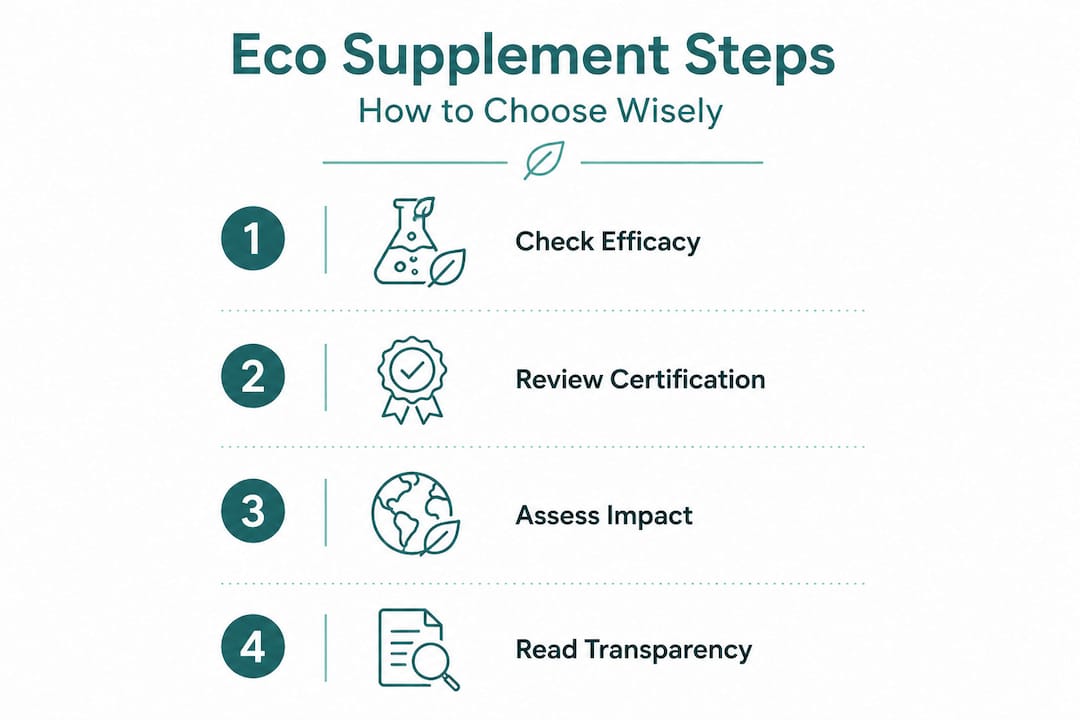
To use these tools practically, follow this prioritised approach:
- Search the brand’s website for published LCA results or third-party environmental audits.
- Check whether the brand holds a B Corp certification, which requires rigorous documentation of environmental and social performance.
- Look for the QI or equivalent nutrient density data in product documentation.
- Review packaging claims critically, noting whether any “eco” statements reference specific, verifiable standards.
- Contact the brand directly if information is unavailable. Transparent companies respond clearly.
Pro Tip: When comparing two products that both claim sustainability credentials, prioritise the one that publishes specific numerical data (such as CO2e per unit) over one that relies on general statements like “environmentally friendly.” Numbers are harder to fabricate than language.
Knowing how to select nutritional products for healthy ageing already involves reviewing efficacy, dosage, and safety. Adding LCA literacy to that process gives you a more complete picture. For a broader foundation, the healthy ageing supplement guide covers the nutritional frameworks most relevant to adults in their 30s through to their 60s.
Sourcing, certifications, and greenwashing risks
Even armed with LCA literacy, consumers face a marketplace where genuine sustainability and polished eco-marketing can look identical at first glance. Credible certifications are the clearest filter available.
Certifications like USDA Organic, Fair Trade, and B Corp each carry specific sustainability benchmarks that brands must meet and maintain through periodic audits. They are not self-declared. USDA Organic prohibits synthetic pesticides and fertilisers across the supply chain. Fair Trade ensures equitable compensation and safe working conditions for ingredient producers, particularly those in lower-income regions. B Corp assesses a company’s overall environmental and social performance using a standardised scoring system, requiring recertification every three years.
Here is a comparison of the three most common certifications:
| Certification | Key focus | Third-party verified | Covers supply chain? |
|---|---|---|---|
| USDA Organic | Agricultural practices | Yes | Partially |
| Fair Trade | Labour and income equity | Yes | Yes |
| B Corp | Overall business ethics and environment | Yes | Partially |
| Non-GMO Project | Genetic modification exclusion | Yes | Yes |
| EU Ecolabel | Reduced environmental impact | Yes | Yes |
Greenwashing remains a serious concern. It occurs when a brand uses eco-language without the verifiable standards to back it up. Common red flags include:
- Vague claims such as “natural,” “green,” or “planet-friendly” with no certification cited
- Self-declared certifications not issued by a recognised independent body
- Ingredient sourcing described in general terms without country or method specifics
- Packaging that highlights one eco feature (such as a recycled box) while ignoring the rest of the supply chain
- Absence of any published environmental reporting or sustainability goals
Pro Tip: Go to the official website of any certification body, such as bcorporation.net for B Corp or fairtrade.net for Fair Trade, and search the brand name directly. If it does not appear, the claim is unverified regardless of what the label says.
Understanding supplement labelling and certifications in detail is one of the most practical skills you can develop as a consumer. For additional guidance on which brands have earned trusted supplement choices status through consistent transparency, real user reviews provide a useful secondary data point alongside certifications.
Environmental impact, efficacy, and user considerations
The supplement industry carries a significant environmental footprint. Industry emissions reached 45 million metric tons CO2e in 2023, with water use and land degradation adding further pressure. Despite this, certified sustainable brands represent only a small share of the total market, meaning the majority of supplements still fall short of meaningful environmental standards.

For adults focused on ageing well, this creates a practical tension: balancing what your body needs with what the planet can sustain. The good news is that the most nutritionally efficient options are frequently the most sustainable ones.
Sustainable spirulina lowers global warming potential compared to conventional sources and also demonstrates superior nutrient absorption in clinical settings. Similarly, food-grown supplements, where active compounds are cultivated within a whole-food matrix rather than synthesised in isolation, tend to offer higher bioavailability alongside a lower environmental footprint. Algae-derived omega-3, for instance, delivers DHA and EPA in forms the body recognises efficiently, without the marine harvesting burden of fish oil.
There are genuine trade-offs to acknowledge. Plant-based options often have lower impacts, but algae-derived products can rival animal sources nutritionally while presenting their own resource considerations around water and energy use in cultivation. Critics also point to the persistent problem of plastic packaging even in otherwise sustainable products, and the risk that intensive mono-cultivation of “sustainable” crops (such as some turmeric or ashwagandha farms) replicates the biodiversity losses associated with conventional agriculture.
Key practical considerations for users:
- Choose supplements in glass, aluminium, or certified compostable packaging where available
- Prioritise food-grown or fermented formulas for better bioavailability and lower processing burden
- Match algae-based omega-3 or B12 to life-stage needs, particularly relevant for those reducing animal product intake after 50
- Review whether a brand discloses its carbon offset strategy or net-zero commitments
- Consider product concentration: higher-potency formulas often mean less frequent ordering and reduced delivery emissions
Following supplement safety tips remains essential throughout, since even the most eco-conscious product must still meet your individual health requirements and be taken correctly to deliver benefit. Sustainability and efficacy are not competing goals. The best products achieve both simultaneously.
Our view: what most guides miss about sustainable supplementation
Most articles on sustainable supplementation stop at a list of certifications and a handful of ingredient swaps. That is useful, but it avoids the harder question: are the sustainability claims you encounter actually meaningful, or are they largely performative?
The industry has an incentive to use sustainability language because consumers respond to it. A recycled cardboard sleeve on a product otherwise sourced through unaudited supply chains does not make a supplement sustainable. A brand with B Corp certification that also publishes annual LCA data and discloses supplier locations is operating at a fundamentally different standard. The distinction matters, and most consumers do not yet know to ask for it.
What we observe consistently is that true sustainability in supplements requires quantifiable transparency, not just visible labels. A QI above 1 is a concrete, independently derived number. A claim of “responsibly sourced” is a sentence. One of these is verifiable; the other is marketing. When you prioritise nutrient density alongside environmental cost, you are making a decision grounded in actual data, and that is more protective of both your health and the environment than any label alone.
There is also a personal dimension that rarely appears in these discussions. Adults in their 40s, 50s, and 60s are navigating real physiological changes: bone density, mitochondrial efficiency, hormone regulation, cognitive function. Choosing supplements that address these needs effectively while also meeting high sustainability standards is entirely achievable, but it requires a higher degree of scrutiny than most people currently apply. The framework exists. The certified options exist. The challenge is learning to use them.
For guidance on how to apply these standards to long-term supplement use, supplement safety and longevity provides a practical starting point grounded in both safety research and evidence-based practice.
Explore sustainable supplementation with Vivetus®
With a clearer understanding of what sustainable supplementation involves, you are better positioned to make choices that align with your health goals and ecological values.
Vivetus® approaches supplementation from a science-led, impact-conscious perspective. The focus is on products supported by robust evidence, transparent sourcing, and meaningful certifications, providing the information and product range needed to make informed decisions. Whether you are reviewing omega-3 alternatives, exploring food-grown vitamins, or reassessing your current supplement stack, Vivetus® provides structured guidance and access to nutritional products designed for adults focused on healthy ageing. Visit vivetus.eu to review the current range and access expert-backed resources for sustainable, long-term vitality.
Frequently asked questions
How do I know if a supplement is truly sustainable?
Look for third-party certifications such as USDA Organic, Fair Trade, or B Corp and check that the brand transparently reports environmental impacts through published LCA data or sustainability audits.
What is the role of life-cycle assessment in supplements?
LCA is a core tool for evaluating sustainability, assessing cradle-to-gate impacts including emissions, water use, and land requirements, and helping consumers compare the true environmental cost of different products.
Are plant-based supplements always the greener choice?
Plant-based options often have lower impacts, but certain algae-based and upcycled animal-derived options can offer strong sustainability and nutrient profiles, making category-level generalisations less useful than product-specific assessment.
Does choosing a sustainable supplement compromise effectiveness?
Nutritional LCA shows that high-quality sustainable options with QI above 1 provide excellent bioavailability with lower adjusted environmental impacts, making them well-suited for ageing vitality without ecological trade-offs.
What should I avoid when shopping for sustainable supplements?
Be wary of vague green claims and absence of transparent sourcing, since greenwashing in nutraceuticals via unsubstantiated eco-labels is a genuine risk that certified, independently verified products help you avoid.