

B vitamins for healthy ageing: what you need to know
TL;DR:
- Many older adults cannot effectively absorb B12, risking energy, cognitive, and health issues.
- Specific groups like vegans, pregnant women, and medication users need targeted B vitamin supplementation.
- Supplement benefits are best realized when testing confirms deficiencies; excessive doses carry health risks.
Many health-conscious adults assume that eating well is enough to maintain optimal B vitamin levels. Yet up to one third of older adults cannot absorb B12 properly due to reduced stomach acid and changes in digestive function that come with age. The result is a hidden shortfall that can quietly erode energy, cognitive sharpness, and long-term wellbeing. This guide cuts through the noise, identifying who genuinely benefits from B vitamin supplementation, what the science actually supports, and how to make informed choices that align with your personal health goals.
Table of Contents
- Who truly needs B vitamin supplements?
- How B vitamins support vitality and brain health
- Evidence: Who really benefits and what does research show?
- Safely supplementing: Testing status and avoiding pitfalls
- A fresh perspective: Beyond the hype, what actually works
- Enhance your wellness with tailored support
- Frequently asked questions
Key Takeaways
| Point | Details |
|---|---|
| B vitamin needs rise with age | Many older adults face absorption issues, raising their risk of deficiency despite a healthy diet. |
| Plant-based eaters need B12 supplements | Vitamin B12 cannot be obtained from plants, making supplementation essential for vegans and vegetarians. |
| Supplements correct, not enhance | Evidence confirms supplements help when there’s a deficiency—extra doses offer little benefit for well-nourished. |
| Food first, then supplement | Prefer food sources for B vitamins unless deficiency or risk factors exist; always test if symptoms are present. |
| Safe supplementation relies on correct dosing | Stick to recommended amounts to avoid nerve damage or masking other health issues. |
Who truly needs B vitamin supplements?
Not everyone requires a B vitamin supplement. However, certain groups face a considerably higher risk of deficiency, and for them, supplementation is not optional but medically prudent. Understanding which category applies to you is the first practical step.
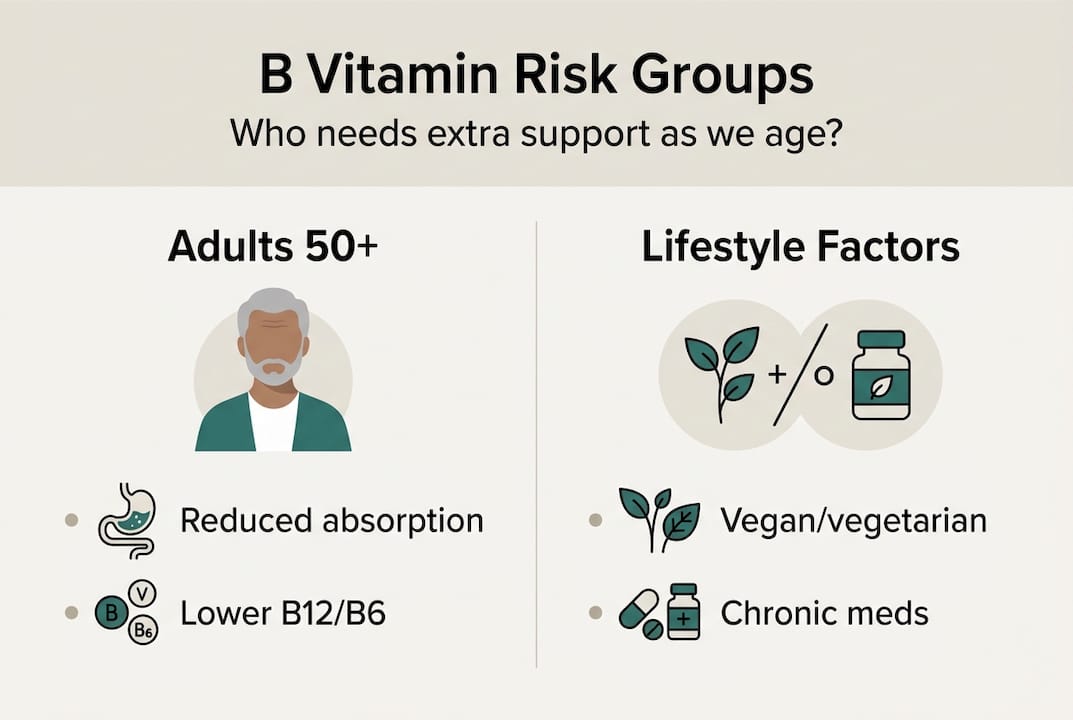
Older adults
As the body ages, the production of intrinsic factor, a protein required for B12 absorption in the gut, declines. Stomach acid, which helps release B12 from food, also reduces. This means that even if an older adult eats B12-rich foods such as meat, eggs, and dairy, a significant proportion of that B12 may never reach the bloodstream. Supplementation is recommended for older adults specifically to prevent the fatigue, anaemia, and cognitive issues that arise from prolonged deficiency.
The same applies to vitamin B6. Absorption efficiency falls with age, and dietary surveys consistently show that older adults tend to consume less B6 overall. This matters because B6 plays a direct role in immune function, mood regulation, and the production of neurotransmitters such as serotonin.
Vegans and vegetarians
Vitamin B12 is found almost exclusively in animal-derived foods. For this reason, vegans and vegetarians need B12 through supplementation or fortified foods to prevent irreversible neurological damage over time. There is simply no reliable plant source of B12, and dietary myths around spirulina or fermented foods providing adequate amounts have been consistently disproven by research.
Vegetarians who consume dairy and eggs do receive some B12, but often not at levels sufficient to maintain optimal stores. Testing is the only reliable way to confirm status.
Pregnant women
The need for folate (vitamin B9) increases sharply during pregnancy to support fetal neural tube development. Public health guidance across Europe and the UK recommends that women trying to conceive and in the first trimester take a folic acid supplement. Deficiency during this period is directly linked to neural tube defects such as spina bifida.
Those on certain medications
Metformin, widely prescribed for type 2 diabetes, reduces B12 absorption over time. Proton pump inhibitors, used for acid reflux, similarly reduce stomach acid and impair B12 uptake. If you take either medication long term, your risk of deficiency is elevated even with a healthy diet. Exploring resources on vitamins for ageing adults can help contextualise how medications and age interact to affect nutritional needs.
| Risk group | Primary B vitamins at risk | Key reason |
|---|---|---|
| Older adults (50+) | B12, B6 | Reduced absorption capacity |
| Vegans and vegetarians | B12 | Absent in plant foods |
| Pregnant women | B9 (folate) | Increased fetal demand |
| Metformin users | B12 | Drug-nutrient interaction |
| Coeliac disease patients | B12, B9, B6 | Impaired gut absorption |
Pro Tip: If you are over 50 or follow a plant-based diet, a simple blood test measuring serum B12 and homocysteine levels can reveal deficiency long before symptoms become apparent. Waiting for symptoms such as fatigue or numbness means deficiency is already advanced.
The advantages of nutritional supplements are most clearly seen in these at-risk groups, where supplementation corrects a genuine physiological gap rather than acting as a performance booster for an already-sufficient system.
How B vitamins support vitality and brain health
Once the need for supplements is clear, it is essential to understand how B vitamins actually work within your body to keep you sharp and energised. Their roles are specific, measurable, and well-documented.
Energy metabolism

B vitamins, particularly B1 (thiamine), B2 (riboflavin), B3 (niacin), B5 (pantothenic acid), and B7 (biotin), are cofactors in the conversion of carbohydrates, fats, and proteins into usable energy. Without adequate levels, this process slows. The fatigue associated with B12 or B9 deficiency is not a vague symptom but a direct consequence of impaired red blood cell production and disrupted cellular respiration.
Homocysteine and cardiovascular risk
One of the most clinically important roles of B vitamins in ageing is their influence on homocysteine, an amino acid that accumulates in the blood when B6, B12, and folate are insufficient. B vitamins support healthy ageing through one-carbon metabolism, which directly regulates homocysteine levels. Elevated homocysteine is an established risk factor for cardiovascular disease and cognitive decline.
Studies have demonstrated that supplementing B6, B12, and folate in adults with high homocysteine reduces blood levels measurably. Whether this translates to fewer cardiovascular events remains a topic of ongoing research, but the biochemical pathway is clear.
Brain structure and cognitive performance
The COSMOS trial, one of the largest and most rigorous multivitamin studies to date, found that multivitamins including B vitamins may improve cognition in older adults in a way equivalent to approximately three years of slower cognitive ageing. This is a meaningful finding, not a trivial one.
Separately, trials specifically in adults with mild cognitive impairment found that B vitamin supplementation significantly slowed brain atrophy in participants with elevated homocysteine. MRI imaging confirmed structural preservation in the B-treated group compared to placebo.
“B vitamins are not merely energy nutrients. In the context of ageing, their role in protecting brain volume and managing vascular risk factors makes them a critical area of focus for anyone prioritising long-term cognitive health.”
| B vitamin | Primary brain-related role | Key deficiency symptom |
|---|---|---|
| B1 (thiamine) | Neural signal transmission | Memory loss, confusion |
| B6 (pyridoxine) | Neurotransmitter synthesis | Depression, irritability |
| B9 (folate) | DNA repair, methylation | Cognitive slowing |
| B12 (cobalamin) | Myelin sheath maintenance | Numbness, memory decline |
For those exploring further, supplements for cognitive health provides additional detail on the evidence base for brain-focused supplementation in adults over 40.
The picture that emerges is consistent: B vitamins are not optional extras for cognitive longevity. They are functional necessities, particularly as absorption capacity and dietary variety shift with age.
Evidence: Who really benefits and what does research show?
With the biological role covered, it is time to scrutinise the claims around B vitamin supplementation for general health. Not all of them hold up equally well under rigorous examination.
What the evidence clearly supports
- Correction of confirmed deficiency restores function. If blood work reveals low B12, supplementation resolves anaemia, neurological symptoms, and fatigue reliably.
- B vitamin supplementation lowers homocysteine in people with elevated levels.
- Cognitive benefits appear most strongly in older adults with existing cognitive impairment and high homocysteine, rather than in the general healthy adult population.
- Folate supplementation during early pregnancy reduces neural tube defect risk by up to 70%.
- Plant-based eaters who supplement B12 consistently avoid the neurological deterioration seen in unsupplemented vegans over the long term.
What the evidence does not support
There is no strong evidence for broad benefits such as cardiovascular disease prevention or a sustained energy boost in well-nourished individuals. This is a common misconception fuelled by marketing rather than clinical data. A well-nourished adult with normal B vitamin status taking high-dose B complex supplements will not experience improved athletic performance, greater mental alertness, or enhanced mood beyond a placebo effect.
“Supplements are not performance enhancers for those already nutritionally replete. The evidence consistently favours their use as corrective tools, not general wellness boosters.”
The Mayo Clinic also notes no proven benefit for B12 supplementation in already-sufficient adults seeking energy improvements or cardiovascular protection. This matters because it shifts the conversation from blanket supplementation to targeted, evidence-led use.
Risks of excess dosing
High-dose B6 in particular, above 50mg per day over extended periods, is associated with peripheral neuropathy, a form of nerve damage causing tingling and loss of sensation in hands and feet. This is not a theoretical risk. Case reports confirm it in individuals self-prescribing high-dose B6 for conditions like PMS or carpal tunnel syndrome without medical guidance.
High-dose folate can mask a B12 deficiency by correcting anaemia while neurological damage continues unchecked. This is a specific danger for older adults and plant-based eaters who may be simultaneously deficient in both.
Pro Tip: Avoid standalone high-dose B vitamin products unless prescribed. A balanced B complex at RDA levels, or a well-formulated multivitamin, is a safer and more rational approach for most adults. Review antioxidants for ageing alongside B vitamins for a more complete picture of age-related supplementation strategy.
Safely supplementing: Testing status and avoiding pitfalls
Let us move from benefits to practical steps: how to supplement wisely and avoid common mistakes that undermine both safety and effectiveness.
Step 1: Identify your risk profile
Before purchasing any supplement, assess whether you belong to a high-risk group. Are you over 50? Do you follow a plant-based diet? Are you taking metformin or a proton pump inhibitor? Do you have a condition affecting gut absorption, such as coeliac disease or Crohn’s disease? If any of these apply, the case for supplementation is strong.
Step 2: Test, do not guess
Testing your B vitamin status through a GP or private blood test is the single most reliable way to confirm deficiency and guide supplementation. Relevant markers include serum B12, red blood cell folate, homocysteine, and methylmalonic acid (a sensitive indicator of functional B12 deficiency). Do not rely on symptoms alone as they are non-specific and often appear only at advanced stages.
Step 3: Prioritise food sources where possible
For those without confirmed deficiency, a diet rich in eggs, dairy, meat, legumes, leafy greens, and fortified foods remains the most appropriate primary strategy. Supplements should fill genuine gaps, not replace dietary diversity. This food-first approach aligns with evidence from public health institutions and clinical guidance.
Step 4: Choose appropriate supplement formats
B12 in the form of methylcobalamin or cyanocobalamin at 25 to 100mcg daily is suitable for most adults over 50. Sublingual (under the tongue) forms may improve absorption for those with gut issues. For confirmed deficiency, injections prescribed by a doctor may be necessary. Supplements for healthy ageing offers a structured overview of how to approach supplementation across different life stages.
Step 5: Stay within safe limits
Follow recommended dietary allowances (RDAs). The RDA for B12 is 2.4mcg daily for adults, though many supplements provide higher amounts, which are generally well tolerated because excess B12 is excreted. However, as noted, high doses carry risks for certain B vitamins, particularly B6. Seek guidance from a healthcare professional before exceeding standard dosage ranges.
- For B6: stay below 10mg daily unless medically directed
- For folate: 400mcg daily is standard; 5mg is medical territory
- For B12: 25 to 100mcg daily is appropriate for most over-50 adults
Review products for healthy ageing for evidence-aligned product selection that fits these guidelines.
A fresh perspective: Beyond the hype, what actually works
Having examined the evidence and practical steps, it is worth reflecting on what genuinely delivers results in the real world.
The supplement industry has been extraordinarily effective at positioning B vitamins as universal energy and performance enhancers. The reality is more measured. For a 35-year-old omnivore eating a varied diet, a B complex supplement is largely unnecessary and delivers no measurable benefit beyond confirmation bias.
The genuine value lies in precision. Identifying the individual at 58 who has been quietly losing B12 absorption capacity for a decade, or the committed vegan who has never supplemented, or the woman on long-term metformin who assumes her diet is sufficient. These are the cases where supplementation produces real, verifiable improvements in wellbeing.
Generic advice fails these individuals by either over-recommending supplements to everyone or dismissing supplementation entirely. The smarter approach is test, target, and track. The evidence-backed advantages of supplements are real, but they belong to the right people, at the right doses, for confirmed reasons.
Enhance your wellness with tailored support
Ready to put your knowledge to practical use in daily wellness?
At Vivetus, we provide access to scientifically supported nutritional products specifically selected for healthy ageing and long-term vitality. Whether you are navigating the complexities of plant-based nutrition, managing the changing needs of a body over 50, or simply seeking clarity on what supplementation is appropriate for your profile, our catalogue is built around evidence-led choices.

Explore our range of products for healthy ageing and access practical resources that help you make informed decisions. From B complex formulations to targeted micronutrient support, Vivetus bridges the gap between research and everyday wellness. Orders over €50 include free shipping across our international delivery network.
Frequently asked questions
Can I get enough B vitamins from a plant-based diet?
Vitamin B12 is absent in plant foods, so vegans and vegetarians must supplement or consume fortified foods consistently to avoid irreversible neurological deficiency over time.
Are B vitamin supplements safe for long-term use?
They are safe at recommended dietary allowance levels, but high doses risk nerve damage (particularly B6) and can mask underlying deficiencies such as low B12 when folate is taken in excess.
Do B vitamin supplements boost energy?
They restore energy levels when fatigue is caused by confirmed deficiency, but no evidence supports a consistent energy boost in adults who already have sufficient B vitamin levels.
How should I test for B vitamin deficiency?
A GP can arrange a blood test measuring serum B12, red blood cell folate, homocysteine, and methylmalonic acid, all of which together give a reliable picture of your B vitamin status.
Are multivitamins with B complex better for cognition in older adults?
The COSMOS trial found that multivitamins including B vitamins may modestly improve cognitive performance in older adults, equivalent to the effect of approximately three years of slower cognitive ageing.